
Steering Wheel Shaking: Causes and Repair Costs
By Oleksandr Potapenko · 2026-11-16 · How we research prices
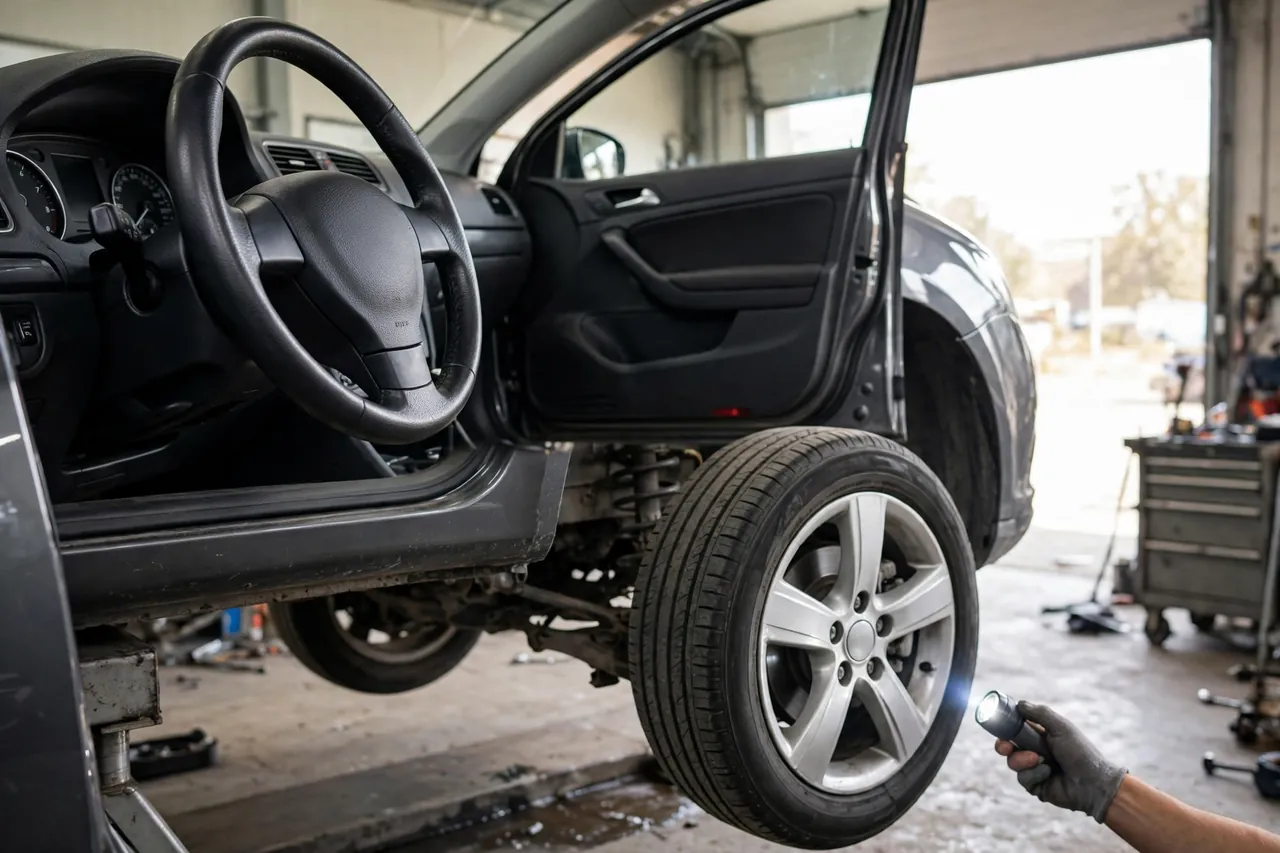
A shaking steering wheel is your car telling you exactly where to look — the speed at which it shakes is the diagnosis. That is the sentence to hold on to, because it turns a worrying symptom into a short checklist. A shake that starts around 90 to 110 km/h and smooths out above that is almost always a wheel balance problem. A shake that appears only when you brake points at the brakes. A shake that is there at low speed and gets worse in turns points at the steering and suspension. A shake that arrived suddenly, with a pull to one side or a new noise, is urgent. Note the speed and the trigger before you call the shop: that information saves a round of guessing and a round of billing.
Wheel balance is the cheapest and most common cause, and the physics is simple. A tire and wheel need small weights on the rim so the assembly spins evenly. A weight falls off — salt and car washes loosen the adhesive — a tire wears unevenly, or a rim bends on a pothole, and the wheel no longer spins true. AAA describes it plainly: vibration in the steering wheel, seat or floor above 45 mph is a sign of imbalance, and a balance service usually fixes it. The vibration typically becomes noticeable around 80 km/h, peaks between 100 and 120 km/h, and may fade at higher speeds — the classic resonant range. AAA's guidance is to balance anywhere from every tire rotation to once a year, because weights shift over time. In Canada, wheel balancing for a set of four runs $55 to $110 CAD, and in winter the cause is sometimes simpler still: snow and ice packed inside the rim throw the wheel badly out of balance, and a car wash fixes it for free. Canadian retail prices back that band: Cansumer's collected Canadian prices put a standalone rebalance at $40 to $50 for four wheels and a mount and balance at $80 to $160 a set, with Kal Tire at $152, and OK Tire lists rotation and balancing at $60 to $120. A puncture repair typically runs $30 to $50 a tire at Canadian retail, against the $40 to $70 in this guide, so the guide's figure is the top of the retail range.
If the balance is fine and the shake remains, the next suspects are the tire itself and the rim. A tire can be balanced correctly and still cause a shake, because of road force variation — a stiff spot in the tire that makes it roll unevenly under the weight of the vehicle. GM's technical service bulletin 00-03-10-006P covers exactly this: smooth-road highway shake, typically at 65 to 70 mph, that persists after standard balancing, diagnosed with load-roller balancing equipment that measures road force variation. A bent rim is the other hidden cause: if one wheel needs far more weight than the others, or will not balance at all, the rim is the problem. A tire puncture repair runs $40 to $70 CAD if the shake turns out to be a damaged tire, and a tire with a bulge or a flat spot from sitting should be replaced, not balanced.
If the shake only happens under braking, the brake rotors are the suspect. A warped or unevenly worn rotor — engineers call it disc thickness variation — pulses through the pedal and the wheel every time you slow down, and AAA lists warped rotors among the top six causes of steering wheel shaking, warning that driving on them can lead to premature wear on suspension components and uneven tire wear. Resurfacing the rotors on an axle runs $95 to $170 CAD if they are still thick enough; if they are scored, rusted, or too thin, a new rotor runs about $80 to $150 CAD each on its own. Our guide Should I Replace Rotors With Brake Pads or Resurface Them? explains when resurfacing is worth it and when it is not.
A shake that is present at all speeds, or that comes with a clunk over bumps, points deeper, into the steering and suspension. A tie rod end runs $210 to $450 CAD each on a car, a control arm $350 to $900 CAD each, and a wheel bearing or hub assembly $480 to $900 CAD each. A worn bearing also hums, and the hum changes when you steer left and right — that is the test you can do yourself on an empty road, and our guide Wheel Bearing and Hub Replacement Cost in Canada explains it in full. RepairPal's September 2026 national averages back the suspension and steering bands in this guide. A wheel bearing replacement averages $346 to $504 per wheel in US dollars, and a complete hub assembly $512 to $652, which convert to about $480 to $695 and $705 to $900 Canadian — the guide's $480 to $900 bearing band covers both. For tie rods, RepairPal's model figures run $212 to $252 for a Ford Explorer, $243 to $283 for a Toyota Corolla, and $352 to $392 for a Volkswagen GTI, and Express Lube's shop survey puts a typical tie rod at $150 to $450 per side in US dollars, which brackets the guide's $210 to $450 Canadian. EngineerFix puts control arm replacement at $200 to over $1,000 per arm in US dollars, and a mandatory alignment after any of these jobs at $50 to $150, against the guide's $350 to $900 control arm and $95 to $150 alignment bands in Canadian dollars. Rotor resurfacing is the one figure where the published guides run higher: ThePricer puts shop-performed resurfacing at $100 to $200 or more per axle in US dollars, against the guide's $95 to $170 Canadian, so treat the guide's figure as the low end for an independent shop, not a dealer price. A shake felt in the seat and floorboards rather than the steering wheel, with a low humming sound, points further back — the driveline rather than the front wheels. The decision rule: start with the balance and a tire inspection, because they are the cheapest answers and the most likely ones. If the balance is fine, ask for an alignment check — a four-wheel alignment runs $95 to $150 CAD on a car, and our guide Wheel Alignment Cost in Canada has the current rates — and a front-end inspection on the hoist. Treat a shake that arrived suddenly, with a pull to one side or a new noise, as urgent: a loose tie rod or a failing bearing can separate, and on a highway at -20°C that is not a repair bill, it is a collision. Check the fair price on the RepairPrice calculator (calculator.php) for whichever repair the diagnosis points to.
Common questions: Q: Why does my steering wheel shake at highway speed? A: Most often a wheel out of balance. AAA lists vibration above 45 mph as the sign, and a balance service usually fixes it. The shake typically peaks between 100 and 120 km/h and may fade above that. Q: Why does my steering wheel shake only when I brake? A: Warped or unevenly worn brake rotors, which pulse through the pedal and the wheel every time you slow down. Q: Can a wheel shake after balancing? A: Yes — road force variation in the tire, or a bent rim, can cause a shake that standard balancing does not fix. Ask for a road force check. Q: Is a shaking steering wheel dangerous? A: A balance shake is annoying but not dangerous. A sudden shake with a pull to one side or a new noise can mean a loose tie rod or a failing bearing, and that is urgent.
| Cause | Typical range (CAD) | Notes |
|---|---|---|
| Wheel balancing, set of 4 | $55–$110 | Shake at 90–110 km/h — check this first |
| Tire puncture repair | $40–$70 | If the shake is a damaged tire |
| Brake rotor resurfacing, per axle | $95–$170 | Shake only when braking |
| New rotor alone | $80–$150 each | If scored, rusted, or too thin |
| Tie rod end, each, car | $210–$450 | Shake plus a clunk over bumps |
| Wheel bearing / hub, each, car | $480–$900 | Shake plus a hum that changes in turns |
| Four-wheel alignment, car | $95–$150 | After any steering or suspension work |




 RepairPrice
