
Starter Motor Replacement Cost in Canada
By Oleksandr Potapenko · 2026-11-16 · How we research prices
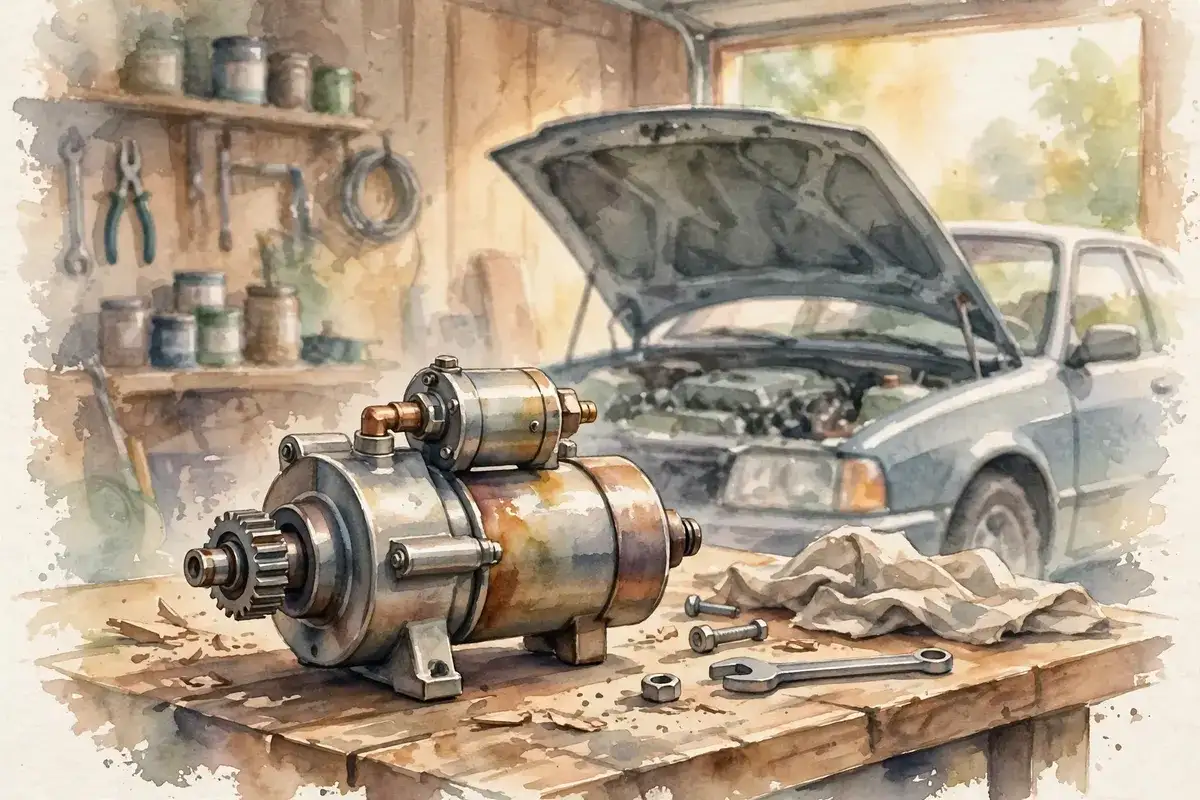
Turn the key and hear one loud click, then nothing. Or hear the engine crank slower and slower until it gives up. Or hear nothing at all. Those three sounds are the whole diagnostic starting point for a starter, and telling them apart before you call a shop can save you the cost of the wrong part. A single click usually means the starter solenoid is engaging but the motor itself is not turning, which points at the starter or at a battery too weak to spin it. Slow cranking points at the battery first. Silence with dashboard lights still on points at the starter circuit, the ignition switch, or a bad connection. The test that separates them costs nothing at most parts stores: a battery load test. If the battery passes and the car still clicks, the starter is the prime suspect.
In Canada, a starter replacement typically costs $450 to $800 for a standard car at an independent shop, $500 to $900 for an SUV or truck, and $600 to $1,100 for a luxury or European car, with dealers above those ranges. WarrantyChick's 2026 Canadian guide puts starters and alternators together at $600 to $1,400 at an independent facility, or $900 to $1,800 at a dealership, depending mostly on access under the hood. That access factor is the whole story on this job. On many four-cylinder cars the starter sits in plain view and the swap takes under two hours. On some V6 and V8 engines, notably certain Toyota, Nissan, and Lexus models, the starter hides under the intake manifold, and labour can double because the manifold has to come off first. Always ask for the labour hours on the estimate: if the book time is four hours on your engine, the quote is not inflated, it is honest.
American estimator data gives the model-by-model picture. RepairPal, updated September 3, 2026, puts the average US starter replacement at $565 to $796. Its model pages show how wide the spread is: a 1991 Toyota Tercel at $265 to $433, a 2008 Highlander at $383 to $543, a Toyota Corolla at $457 to $616, a 2012 Camry at $480 to $772, and a 2018 Camry at $560 to $793. A 2019 Toyota 86, where access is awkward, runs $596 to $1,563. The same conflict seen with alternators shows up here too. ARI analysed 556,458 real invoices from 3,622 independent US shops from November 2025 to October 2026 and reports a starter median of $375, with the middle half of invoices between $250 and $500. RepairPal prices OEM-grade parts and dealer-tier labour; ARI's invoices reflect what independent shops actually install, often a quality remanufactured starter. Both numbers are true. The one that matches your quote depends on the part on the estimate, so ask which it is.
Before you approve a starter, rule out the three cheaper pretenders. First, the battery: a weak battery produces the exact same click or slow crank, and a battery costs a third of a starter. Second, the cables and terminals: corrosion on the battery terminals or a loose ground strap starves the starter of current, and cleaning them costs almost nothing. Third, the starter relay and the ignition switch, both cheap parts that fail in ways that look exactly like a dead starter. A competent shop tests the battery, checks voltage at the starter while cranking, and only then condemns the motor. If a shop quotes a starter without testing the battery, get a second opinion. Our guide Car Won't Start: Battery, Starter, or Alternator? lays out the full three-way test, and Car Battery Replacement Cost in Canada covers the battery side of the bill.
The repair-versus-replace question barely exists for starters: a failed starter gets replaced, not rebuilt in the car. The real choice is new versus remanufactured, and dealer versus independent. A quality remanufactured starter from a reputable brand, with at least a one-year parts and labour warranty, is the sensible default for most cars over five years old and typically saves $100 to $250 against a new unit. A new OEM starter is the right call on a newer car, a car you plan to keep for many years, or a model where remanufactured units have a poor track record. The dealer premium buys the factory part and the scan tools, but on most mainstream cars an independent shop does this job for 30 to 40 percent less. One caution: on cars where the starter is buried under the intake manifold, pay for the extra work once and do it right. Replacing the manifold gaskets while everything is apart costs little extra in parts and prevents a vacuum leak comeback.
Cold weather deserves a special note, because starters fail most often on the coldest mornings of the year. The oil is thick, the battery is at its weakest, and the starter has to work hardest exactly when it has the least help. That is why a starter that was marginal in October becomes a no-start in January. If your car cranks slowly on a cold morning, do not wait for the minus 30 day to find out whether it was the battery or the starter. Test the battery now, and if it is weak, replace it before winter; a fresh battery often saves a starter that was never actually broken. For the full winter checklist, see Winter Car Prep in Canada: What Actually Matters. And before you approve any quote, run it through the RepairPrice calculator (calculator.php) and compare it with How Do I Check If a Repair Quote Is Fair?
Common questions:
Q: How much does a starter replacement cost in Canada? A: Typically $450 to $800 for a standard car, $500 to $900 for an SUV or truck, and $600 to $1,100 for a luxury car at an independent shop, with dealers higher. The biggest variable is access: starters buried under the intake manifold can double the labour.
Q: Can I drive with a bad starter? A: You cannot rely on it. A failing starter may work ten times in a row and then refuse on the eleventh, usually far from home. If it clicks or cranks slowly, get it tested the same week rather than gambling on the next cold morning.
Q: Is it the starter or the battery? A: Slow cranking points at the battery; a single loud click with a good battery points at the starter; silence with lights on points at the starter circuit. A free battery load test at a parts store settles the first question, and a voltage check at the starter while cranking settles the second.
Q: Should I buy a new or remanufactured starter? A: A quality remanufactured starter with a one-year or better warranty is the sensible default for most cars over five years old. Buy new OEM if the car is newer, if you plan to keep it for many years, or if remanufactured units have a poor record on your model.
| Vehicle | Typical range | What moves the price |
|---|---|---|
| Standard car | $450–$800 | Parts $250–$500, ~1.5–2 hours labour |
| SUV / truck | $500–$900 | Larger engine, pricier starter |
| Luxury / European | $600–$1,100 | Buried location, factory parts |
| Starter under intake manifold | Well above average | Labour doubles on some V6/V8 engines |
| Remanufactured starter | Below new-part price | Reputable brand + labour warranty matters |
| Dealer replacement | Above the range | Factory part, higher labour rate |




 RepairPrice
