
Radiator Replacement Cost in Canada
By Oleksandr Potapenko · 2026-11-16 · How we research prices
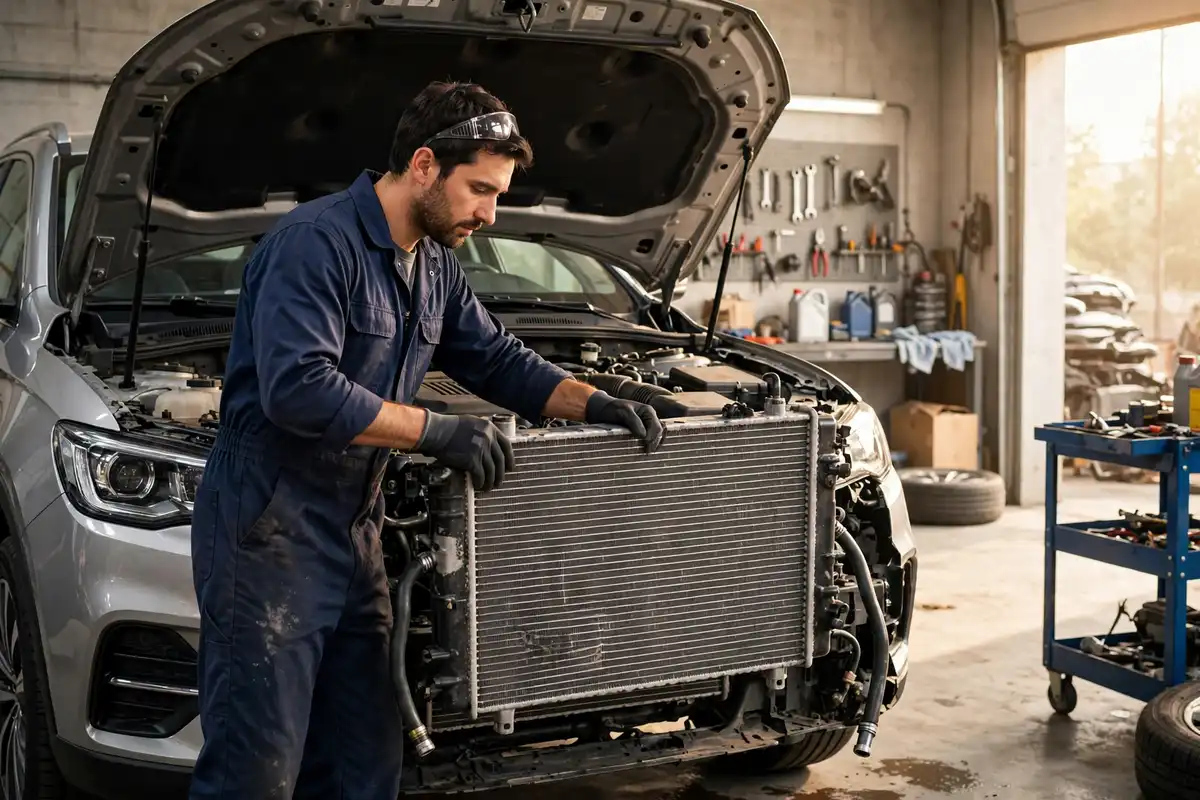
A stone flicked up off a winter highway, a plastic end tank gone brittle after ten freeze-thaw seasons, a slow green stain creeping along a seam. That is how most Canadian radiators die, and the bill that follows depends almost entirely on which of those three stories yours is. Replacing a radiator on a typical car in Canada costs roughly $550 to $1,050 at an independent shop. Canada Buzz, a Canadian cost guide, puts a full radiator replacement at $300 to $900, with minor repairs averaging around $90. RepairPal's September 2026 US estimates tell a higher story: $874 to $954 US for a 2008 Avalon, $780 to $883 US for a 2021 Tundra, and $1,162 to $1,424 US for a 2022 Highlander, which convert to roughly $1,075 to $1,315, $1,075 to $1,220, and $1,600 to $1,965 in Canadian dollars. The gap between the two sources is real and worth understanding before you accept a quote.
Canada Buzz is describing the independent-shop world of aftermarket radiators, where the part itself costs $180 to $450 and the job takes about two and a half hours. RepairPal's figures lean toward factory parts and dealer-level labour, and its Highlander numbers include a radiator with an integrated transmission cooler, which is a more expensive part by design. Neither source is wrong. If your shop quotes $600 for a Corolla with an aftermarket radiator, that is Canada Buzz's world. If it quotes $1,500 for a Highlander with a factory radiator and a transmission cooler built in, that is RepairPal's world. The quote to be suspicious of is the one in the middle with no parts breakdown: ask whether the radiator is factory or aftermarket, whether it includes the transmission cooler, and whether fresh coolant and a bleed are in the price. A radiator job that reuses old coolant is a job done halfway.
The radiator's job is simple to describe and hard to do without: it dumps engine heat into the air passing through the grille. When it fails, the engine overheats, and the first signs are usually small. A sweet smell after parking, a puddle of green, orange, or pink fluid under the front of the car, a temperature gauge that climbs in traffic but settles on the highway, a coolant level that keeps needing top-ups with no obvious leak anywhere else. The gauge pattern matters: overheating only in traffic points at the fan, which our guide "Radiator Fan Not Working: Diagnosis and Repair Cost" covers, while overheating at highway speed points at the radiator itself, the pump, or the thermostat. Plastic end tanks deserve a special mention in Canada. Most modern radiators are an aluminum core with plastic tanks crimped onto the ends, and after eight to twelve years of hot-cold cycles those tanks turn brittle. A crack in a tank cannot be patched reliably, and a shop that offers to seal it is selling you a tow bill in a few weeks.
Before you approve a radiator, make the shop prove the radiator is the problem. A leaking hose or a loose clamp costs $100 to $200 to fix and looks exactly like a radiator leak from underneath the car. A pressure test of the cooling system, which most shops do for the cost of the diagnostic hour, finds the real leak in minutes. If the radiator is genuinely clogged inside, which happens when coolant changes have been skipped for years, flushing rarely saves it: the passages are narrow, and a clogged radiator that has been flushed once tends to clog again. Our guide "Coolant Flush Cost in Canada" explains the service intervals that keep a radiator alive, and the short version is that Toyota's Super Long Life coolant is due first at 10 years or 100,000 miles and Honda's at 5 years or 60,000 miles, so a radiator that dies at 200,000 kilometres usually died of old coolant.
The decision rule is straightforward. Repair the radiator only if the leak is a hose, a clamp, or the cap; a $15 to $40 cap from SuperCarDigest's 2026 pricing, or a $90 minor repair from Canada Buzz, is the only radiator-area fix worth doing twice. Replace the radiator if a tank is cracked, a seam is weeping, or the core is clogged. And replace the hoses and clamps at the same time, because hoses the same age as a failed radiator are next in line, and the coolant is already out. On a car worth less than about $3,000, weigh the repair against the car's value the same way our guide "Engine Rebuild vs Replace: The Decision in Canada" weighs bigger jobs: a $1,000 radiator on a car with a rusted frame and a slipping transmission is money better saved. Check the range for your own car with the RepairPrice calculator (calculator.php) before you call around, and get two written quotes, because radiator prices vary more between shops than almost any other cooling repair.
Common questions:
Q: How much does it cost to replace a radiator in Canada? A: Roughly $550 to $1,050 for a typical car at an independent shop, according to Canada Buzz's $300 to $900 range and RepairPal's US model estimates converted to Canadian dollars. SUVs with integrated transmission coolers run higher, often $1,100 to $1,600 or more with a factory part.
Q: Can a radiator be repaired instead of replaced? A: Only small things: a cap, a hose, or a clamp. A cracked plastic end tank or a clogged core cannot be repaired reliably. Sealant products may slow a small leak for a while, but SuperCarDigest's 2026 guide warns they will not fix a split hose, a failed pump seal, or a cracked plastic tank.
Q: How long does a radiator last? A: Typically 8 to 12 years or 150,000 to 250,000 kilometres, depending on coolant maintenance. Cars whose coolant was changed on schedule, such as Toyota's 10-year first interval, usually see the radiator outlive the car; cars run on old, acidic coolant can need one much sooner.
Q: Can I drive with a leaking radiator? A: Only as far as the nearest safe stop, with the heater on full to shed heat and the gauge watched constantly. A leak that empties the system leaves the engine with no cooling at all, and the result is a warped head or a blown head gasket, which our guide "Head Gasket Repair Cost in Canada" prices at several times the cost of a radiator.
| Job | Typical range, independent shop (CAD) | What moves the price |
|---|---|---|
| Radiator, car | $550–$1,050 | Canada Buzz $300–$900; RepairPal Avalon $874–$954 US converted |
| Radiator, SUV/truck | $700–$1,400 | Larger radiator, integrated cooler; RepairPal Highlander $1,162–$1,424 US |
| Radiator, luxury | $900–$1,800 | Parts and labour rate; factory part costs far more |
| Plus hoses and clamps | $80–$200 extra | Old hoses are often next to fail |
| Fresh coolant + bleed | Should be included | Old coolant should not go back in |


 RepairPrice
