
O2 and MAF Sensor Replacement Cost
By Oleksandr Potapenko · 2026-11-16 · How we research prices
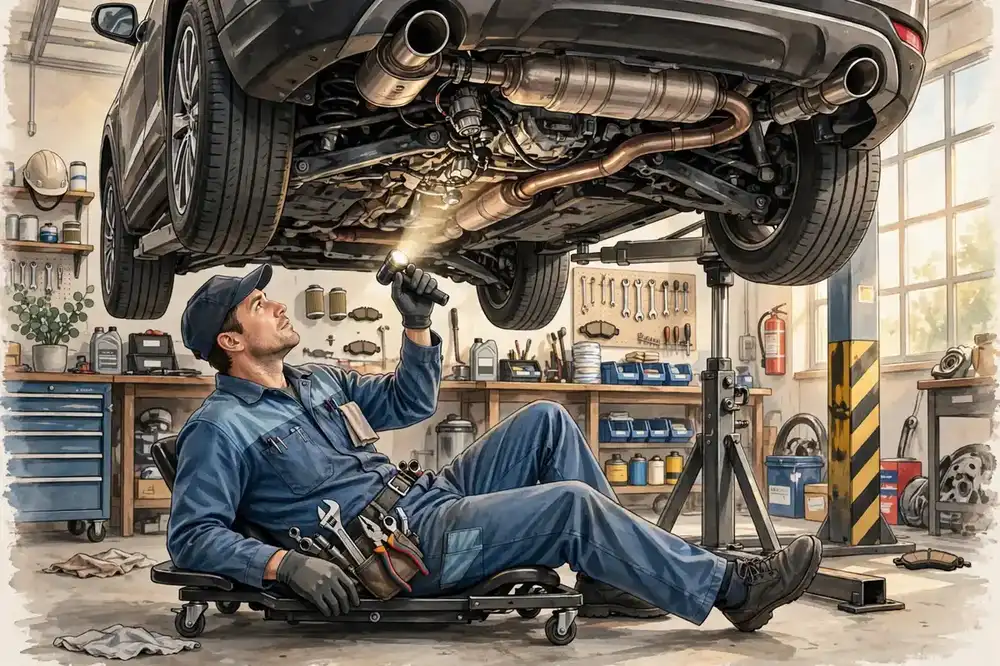
Two small sensors do much of the work of keeping your engine running efficiently, and they fail in ways that look identical from the driver's seat, which is why they are so often replaced on a guess. The oxygen sensors in the exhaust measure how much oxygen remains after combustion and tell the engine computer whether the fuel mixture is rich or lean. The mass airflow sensor, sitting in the intake, measures how much air enters the engine. When either fails, the computer guesses, and guesses badly: fuel economy drops, the engine idles rough or hesitates, and the check engine light comes on. A failed oxygen sensor is also one of the most common reasons a car fails an emissions test. The real numbers are refreshingly concrete. A real Ontario shop estimate from June 2026 for a 2016 Toyota RAV4 shows the job exactly: an oxygen sensor at $99.59 plus one hour of labour at $90, for a total of $214.24 including tax. That is the shape of the bill on a common car, and it is worth holding in mind when a quote comes in at twice that figure.
An oxygen sensor replacement on a typical car in Canada runs roughly $175 to $350 at an independent shop, based on $80 to $220 for the sensor plus about an hour of labour. A MAF sensor replacement runs roughly $150 to $365, from $100 to $300 for the sensor plus about half an hour of labour, since it is usually a quick swap once diagnosed. The United States figures frame the same job: ARI's real-invoice data puts the median oxygen sensor job at $212 US, with a typical range of $143 to $314 US, and AAA puts a representative oxygen sensor repair at $350 to $400 US. RepairPal's model pages show how wide the spread runs by car: a 2010 Jeep Patriot at $123 to $321 US, a 2007 Ford Escape at $270 to $377 US, a 2000 Honda Civic at $268 to $662 US, and a 2013 Toyota Highlander at $704 to $818 US. The expensive ones are wideband air-fuel ratio sensors, which cost far more than a basic narrowband sensor and are common on Toyotas and European cars. A Bosch direct-fit wideband sensor retails for $109.99 US, but some original-equipment sensors cost several hundred dollars before labour. MAF sensors show the same spread: RepairPal puts a Toyota Camry MAF at $287 to $357 US, while older Toyota trucks run over $1,400 US because the sensor is an expensive dealer-only part. SUVs run about 15 percent higher and luxury models about 35 percent higher in Canada, and upstream oxygen sensors, before the catalytic converter, matter more for fuel mixture than downstream ones, which mainly monitor the converter itself. Many cars have three or four oxygen sensors, so confirm which one is quoted.
Diagnosis matters because these sensors are often blamed for problems they did not cause, and this is where the money is saved or wasted. A dirty MAF sensor can sometimes simply be cleaned with a dedicated spray, a cheap fix worth trying before replacement, though never with brake cleaner or compressed air, which damage it. An oxygen sensor code can also be triggered by an exhaust leak upstream, a vacuum leak, or a failing catalytic converter. A good shop checks for those before selling you a sensor, and shows you the live data or the code that points to the specific sensor. The decision rule is to replace only the failed sensor, except on a high-mileage car, where the matching sensor on the other bank is often close behind, and doing both upstream sensors together can save a second labour charge later. Always fix what killed the sensor: a sensor fouled by burning oil or coolant will fail again within months if the leak is not fixed, and the oil story is covered in High Oil Consumption: Causes and Repair Cost in Canada. Do not ignore a sensor fault for months. Running rich washes oil from the cylinder walls and can overheat the catalytic converter, turning a $200 sensor job into a converter bill in the thousands. A sensor code with no drivability symptoms is still worth fixing promptly, and it is one of the cheapest check-engine-light fixes there is. Check the fair price for your exact car on the RepairPrice calculator (calculator.php) before you approve the quote.
Common questions:
Q: How much does it cost to replace an oxygen sensor in Canada? A: Roughly $175 to $350 for one sensor on a typical car at an independent shop. A real Ontario estimate for a 2016 RAV4 was $214 including tax. Wideband sensors on Toyotas and European cars can run $600 to $800 or more.
Q: How many oxygen sensors does a car have? A: Usually two to four: one upstream and one downstream sensor per exhaust bank. The upstream sensor controls the fuel mixture, the downstream sensor monitors whether the catalytic converter is still working.
Q: Can I drive with a bad oxygen sensor? A: Short trips are usually fine, but fuel economy drops, the engine can run rough, and the catalytic converter is at risk, so it is a this-week repair, not a someday one. In most jurisdictions a lit check engine light is also an automatic emissions test failure.
Q: Can a MAF sensor be cleaned instead of replaced? A: Sometimes, yes. A dirty MAF sensor can often be cleaned with a dedicated MAF spray, which is a cheap fix worth trying first. Never use brake cleaner or compressed air, which damage the sensor element.
| Job | Typical range, independent shop | Notes |
|---|---|---|
| Oxygen sensor, car | $175–$350 | Sensor $80–$220 + ~1 h labour |
| MAF sensor, car | $150–$365 | Sensor $100–$300 + ~0.5 h labour |
| Real Ontario invoice, 2016 RAV4 O2 | $214 incl. tax | Sensor $99.59 + 1 h at $90 |
| Wideband air-fuel sensor | $600–$800+ | Common on Toyota and European cars |
| SUV/truck or luxury | +15% / +35% | Parts and labour rate |
| Dirty MAF sensor | Try cleaning first | Dedicated MAF spray only |
| Confirm which sensor | Upstream vs downstream O2 | Many cars have 3–4 O2 sensors |


 RepairPrice
