
Muffler Replacement Cost in Canada
By Oleksandr Potapenko · 2026-11-16 · How we research prices
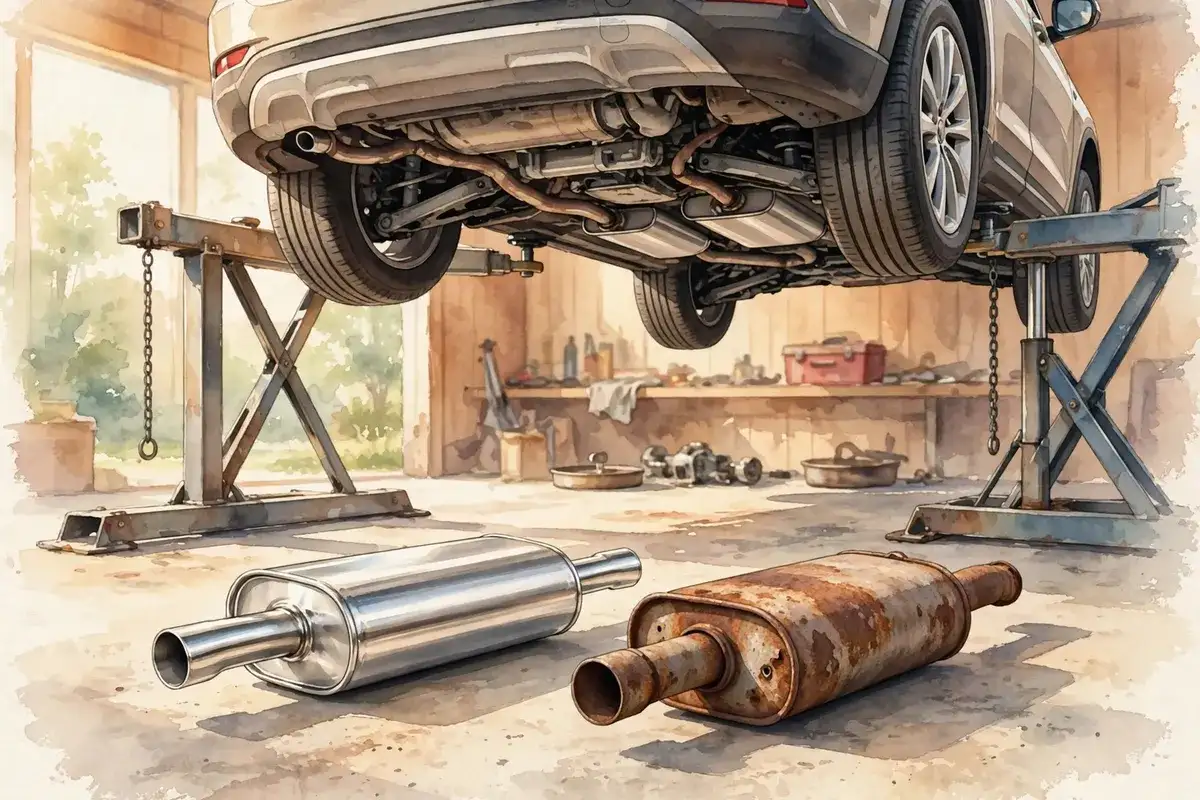
One January morning your car suddenly sounds like a farm tractor at every stoplight. Nothing changed overnight except the temperature, and that is the clue: in Canada the muffler is usually the first exhaust part to give up, because road salt eats it from the outside while condensation eats it from the inside, and short winter trips never get it hot enough to dry out. A muffler that was fine in October can be roaring by February, and the bill that follows depends far more on which car you drive and which part you choose than on the labour.
For a mainstream car, replacing a muffler in Canada typically costs CAD $300 to $650 all-in. That range comes from CarInterior's Canada figure of CAD $300 to $650, and it lines up with a real Ontario invoice we checked: United Motorz in Cambridge, Ontario, billed a 2016 Ford Fiesta muffler at $319.48 including HST in April 2026. RepairPal's US model estimates, in US dollars, show why the range is so wide: a 2008 Toyota Yaris runs $316 to $344, a 2005 Toyota Echo $353 to $385, while a 2015 Toyota RAV4 runs $623 to $674 and a 2017 Toyota Highlander $848 to $882, with the part alone around $513 on the RAV4 and $775 on the Highlander. Ottawa Stories, rounding up Ottawa shop prices, puts a new muffler at $500 to $900 before labour. The honest reading is that a small sedan with an aftermarket muffler sits at the bottom of the range, and a larger vehicle with a factory muffler sits at the top, sometimes double. Canadian prices run higher than the US figures in nominal dollars, and every quote below is in Canadian dollars before tax.
A muffler does not have a factory replacement interval, but in salt country five to seven years is a realistic life, according to Autodana's 2026 muffler guide. The failure is almost always rust, and it starts where water sits: the bottom of the can and the seams. Short trips are the worst pattern, because the exhaust never gets hot enough to evaporate the water that condenses inside it overnight. If you keep the car for years in Ontario, Quebec or the Atlantic provinces, that is the single best argument for paying more for the part itself.
The symptoms are hard to miss, but they are not all the same problem. A sudden roar is usually a hole or a split seam. A rattle from under the rear is often a broken internal baffle or a rusted hanger, not a dead muffler at all. And exhaust fumes inside the car are a safety problem, not a noise problem: carbon monoxide is odourless, and a leak ahead of the muffler can push it into the cabin, so that one means stop driving and get it checked the same day. If a section is hanging or dragging, look underneath before driving far, because a muffler held by one rusted hanger can drop onto the road.
Here is the decision rule that saves most people money. First, get the car on a hoist and have the shop show you the rust before you approve anything; a good exhaust shop does this without being asked. If the metal around the hole is paper-thin, replacement is the honest answer, because a patch just moves the hole a few centimetres down the pipe. If the muffler itself is solid and only a hanger or clamp has failed, that is a small repair, well below replacement cost, and Best in Ottawa's shop survey puts minor muffler repairs at $30 to $400. Second, if you plan to keep the car three or more winters, buy the stainless steel muffler: it costs more up front and lasts far longer where roads are salted, while a basic aluminized steel unit is the right call on a car you plan to sell within a year or two. Third, ask for an itemized quote that lists the muffler, the hangers and any connecting pipe separately, so you can see whether you are paying for one part or half the exhaust system, and confirm new hangers are included, since reusing rusted hangers on a new muffler is a false economy. If the quote also covers the mid-pipe or the resonator, read our guide Exhaust Pipes, Flex Pipe, and Resonator Costs before you approve it, and use the RepairPrice calculator (calculator.php) to check the total against the fair range for your car.
In Quebec shops you will hear the muffler called a silencieux, and the quote will use the same word, so do not be confused if the paperwork says something different from what you expected. A dealer will usually quote a factory muffler and a higher labour rate, while an independent exhaust specialist will usually offer an aftermarket or stainless option at a lower total; for a muffler, which is a bolt-on or weld-on part with no electronics, the independent shop is the sensible default unless the car is still under warranty.
Common questions:
Q: How long does a muffler last? A: In Canada, typically five to seven years, according to Autodana, and less on cars that only do short winter trips, because condensation never evaporates. A stainless steel muffler lasts considerably longer in the same conditions.
Q: Can I drive with a broken muffler? A: A short, slow drive to a shop is usually fine if the exhaust is still attached, but do not ignore fumes inside the car, a dragging section, or a sudden huge increase in noise. Fumes mean possible carbon monoxide in the cabin, and a dragging muffler can fall off or catch on something.
Q: Is it OK to replace just the muffler, or should I replace the entire exhaust system? A: Replace just the muffler if the rest of the system is solid. If the pipes on either side are paper-thin with rust, replacing one section just moves the next failure a few months down the road, and a full mid-section in stainless steel can be better value than three separate mild-steel repairs.
Q: What is the difference between an OEM muffler and an aftermarket muffler? A: An OEM muffler is made by the vehicle's manufacturer and fits exactly, at the highest price. An aftermarket muffler is made by another company, often costs much less, and is usually the better value on an older car, as long as it is the correct fit for your model and, where relevant, stainless steel.
| Vehicle | Typical range | What moves the price |
|---|---|---|
| Standard car | $300–$650 | Parts $100–$400, ~1–1.5 hours labour |
| SUV / truck | $400–$850 | Larger muffler, dual exhaust |
| Luxury | $550–$1,050 | Factory parts, dual or valved systems |
| Stainless steel muffler | Above basic steel price | Lasts far longer in salt country |
| Hanger or clamp only | $80–$200 | Rattling is not always a dead muffler |


 RepairPrice
