
Heater Hose Replacement Cost in Canada
By Oleksandr Potapenko · 2026-11-16 · How we research prices
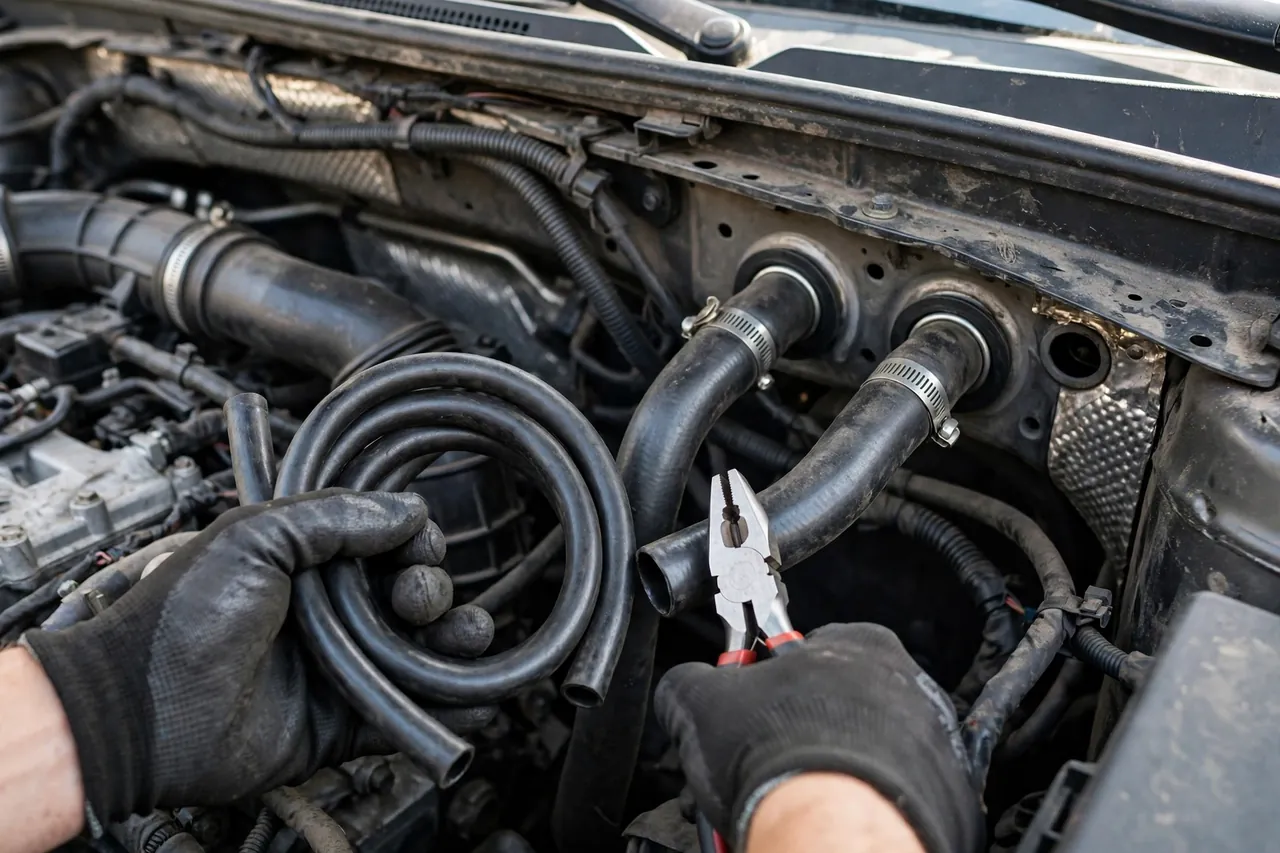
It is minus thirty on a January morning in Edmonton, the windshield is fogging from the inside, and the heater is blowing lukewarm. Or the carpet on the passenger side is damp, and the car smells sweet every time you get in. Those are heater hose symptoms, and they are easy to dismiss right up until the hose bursts on the highway and dumps the coolant in seconds. Heater hoses carry hot coolant from the engine to the heater core behind the dashboard, and they are the reason the cabin warms up at all. They are rubber, they live in a hot engine bay, and after eight to twelve years they go soft, swell, or crack at the clamps. A weeping hose is a repair to schedule this week, not next season.
Replacing a heater hose in Canada costs roughly $430 to $650 for a typical car at an independent shop, and the range is an estimate from RepairPal's September 2026 US model figures converted at about 1.38 Canadian dollars to the US dollar. A 2002 Toyota Corolla heater hose is $379 to $442 US, a 2009 Ford Ranger is $311 to $374 US, a 2007 Toyota Highlander is $506 to $586 US, and a 1998 Toyota Land Cruiser is $609 to $661 US, which convert to roughly $430 to $515, $520 to $610, $700 to $810, and $840 to $910 Canadian. Those are the simple cases, where the hose is a plain rubber section with two clamps. The expensive cases are the moulded hose assemblies on newer SUVs and vans, where the hose comes bonded to plastic connectors, quick-connect fittings, and sometimes a valve: a 2007 Dodge Caravan is $627 to $707 US, a 2015 Chevrolet Volt is $1,018 to $1,132 US, a 2022 Chevrolet Suburban is $1,166 to $1,246 US, and a 2017 Ford Expedition is $1,155 to $1,229 US, converting to roughly $865 to $975, $1,405 to $1,560, $1,610 to $1,720, and $1,590 to $1,695 Canadian. RepairPal's own data shows why: on the 2003 Chevrolet Venture, the labour is only $49 to $72 US while the part is about $1,237 US, because the assembly is the whole cost. YourMechanic's estimator tells the same story at a lower level: its average heater hose replacement is $147 to $285 in US dollars across common models — $147 for a Nissan Altima, $176 for a Chevrolet Malibu, $189 for a Subaru Legacy — with $52 to $94 for parts and $95 to $171 for labour, while its shop and dealer prices for complex assemblies run past $1,000. RepairPal's figures sit above YourMechanic's mobile-mechanic averages because RepairPal prices dealer parts and shop labour; the Canadian range in this guide follows RepairPal's end for a shop job, and a mobile-mechanic quote should land nearer YourMechanic's. Ask your shop whether your car needs a plain hose or a moulded assembly before you compare quotes, because a $500 quote and a $1,500 quote can both be correct for different cars.
The symptoms tell you where the leak is, and the location decides the bill. A sweet smell inside the car, fog on the inside of the windshield that will not clear, and damp carpet on the passenger side mean the leak is at the heater core, inside the cabin, and that is a different and much bigger job, which our guide "Heater Core Replacement Cost in Canada" prices. A sweet smell under the hood, a puddle under the car, and a coolant level that keeps dropping mean the leak is a hose in the engine bay, and that is the job this guide prices. A hose that is soft and swollen at the clamps, or cracked where it meets the fitting, is a hose that has already failed; squeeze the hoses when the engine is cold, and replace any that feel mushy or show surface cracks. The heater hoses are the same age as the radiator hoses, the thermostat, and the coolant, which is why a shop that is already replacing one should be checking the others, and why our guides "Thermostat Replacement Cost in Canada" and "Coolant Flush Cost in Canada" are the natural companions to this one.
The decision rule has two parts. First, replace both heater hoses together, not just the one that is leaking, because they are the same age, they live in the same heat, and the second one will fail soon after the first, usually at the worst possible moment. Second, replace the clamps and the coolant at the same time: new clamps cost almost nothing, old spring clamps lose their tension, and the coolant has to be drained for the hose anyway, so a flush costs little extra at that moment. A pressure test before the work confirms the leak is the hose and not the heater core or the water pump, and a pressure test after the work confirms the repair holds. If the car is a minivan or a large SUV with a rear heater, remember there are rear heater hoses too, running under the car to the back, and they fail the same way, often from road salt and stone damage underneath rather than heat.
Do not keep driving on a weeping heater hose. A hose that bursts on the highway dumps the coolant in seconds, the engine overheats in minutes, and the repair that follows is a head gasket, which our guide "Head Gasket Repair Cost in Canada" prices far above any hose. If the gauge climbs, pull over, shut the engine off, and call a tow. A do-it-yourselfer can replace a plain heater hose with basic tools in an hour or two, but the moulded assemblies with quick-connect fittings are a different job: the plastic connectors are brittle with age, they break if they are forced, and a broken connector turns a hose job into a fitting replacement. Know which one your car has before you decide. Check the range for your car with the RepairPrice calculator (calculator.php), and ask the shop to name the part: a plain hose, a moulded assembly, and a heater core are three different bills, and the quote should say which one you are paying for.
Common questions:
Q: How much does it cost to replace a heater hose in Canada? A: Roughly $430 to $650 for a typical car with a plain hose, based on RepairPal's September 2026 figures for a Corolla at $379 to $442 US and a Ranger at $311 to $374 US, converted at about 1.38. YourMechanic's averages run lower, $147 to $285 US for common models, because they are mobile-mechanic prices rather than shop prices. Moulded hose assemblies on SUVs and vans cost far more: a 2022 Suburban is $1,166 to $1,246 US and a 2017 Expedition is $1,155 to $1,229 US.
Q: What are the symptoms of a bad heater hose? A: A sweet smell under the hood or inside the car, a coolant level that keeps dropping, a hose that feels soft or swollen at the clamps, and a heater that blows lukewarm. A sweet smell inside the car with damp passenger carpet and fogging windows points to the heater core instead, not the hose.
Q: Can I drive with a leaking heater hose? A: Only as far as the nearest safe stop. A hose can burst without warning and dump the coolant in seconds, and the engine overheats in minutes. A weeping hose is a repair to schedule this week.
Q: Should both heater hoses be replaced at the same time? A: Yes. They are the same age and live in the same heat, so the second one usually fails soon after the first. Replace the clamps and the coolant at the same time too, since the system is already drained.
| Service | Typical range (CAD) | Notes |
|---|---|---|
| Heater hose replacement, car | $430–$650 | RepairPal Corolla $379–$442 US, Ranger $311–$374 US, converted |
| Heater hose assembly, SUV/van | $650–$1,700 | Moulded assembly; Expedition $1,155–$1,229 US, Suburban $1,166–$1,246 US |
| Diagnostic + pressure test | $120–$180 | Overheat history and warning lights |
| Coolant flush, car | $165–$260 | Often done with a hose replacement |
| Thermostat replacement | $250–$600 | Same age as the hoses — check together |
| Water pump replacement | $650–$950 | Another leak point in the same system |
| Radiator replacement | $550–$1,050 | Radiator $180–$450 + about 2.5 h labour |
| Heater core replacement | $850–$1,450 | The leak is inside the cabin, not the hose |


 RepairPrice
