
Fuel Pump Replacement Cost in the USA
By Oleksandr Potapenko · 2026-11-16 · How we research prices
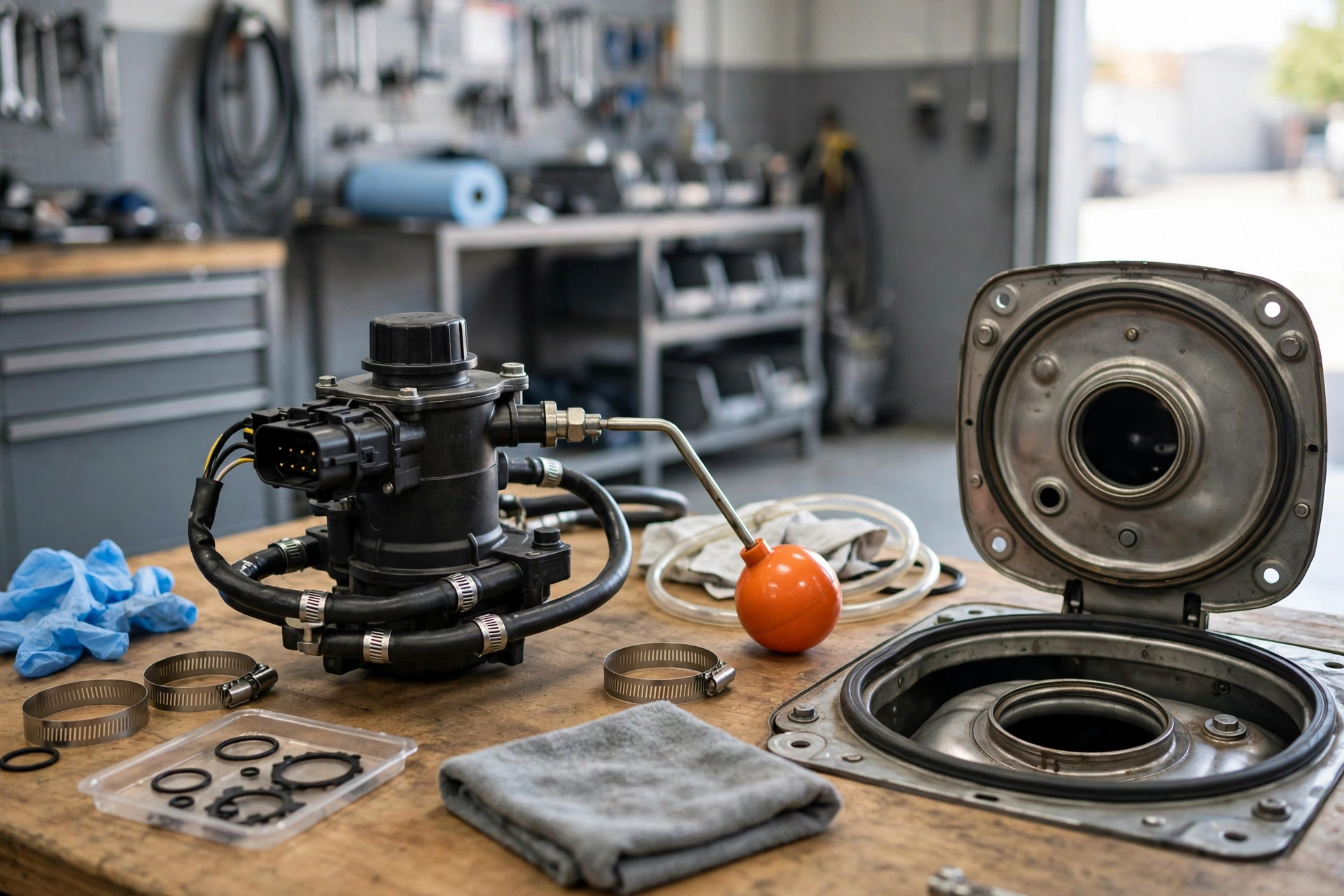
The first thing to know about fuel pump prices in the United States is that the published estimates disagree by more than a thousand dollars — and every one of them is honest. RepairPal's national estimate, updated September 3, 2026, puts a fuel pump replacement at $1,344 to $1,513, with parts of $1,104 to $1,160 and labour of $241 to $353. Kelley Blue Book puts the same job at $390 to $900 on one page and $1,000 to $1,300 on another. AutoZone's professional-install figure is $400 to $600. AAA, citing Consumer Affairs data, puts a typical shop bill at $1,150 to $1,400. ConsumerAffairs itself puts the average at $1,247 to $1,506. The spread is not sloppiness; it is three different jobs wearing one name. RepairPal prices a complete original-equipment module — pump, fuel-level sender and strainer, the whole assembly that drops into the tank. KBB and AutoZone reflect an aftermarket pump on a simpler car. AAA and ConsumerAffairs sit in between, because their figures mix both. The question is never "what does a fuel pump cost" in the abstract. It is "which part, on which car, reached how."
The model-by-model numbers make the point better than any average. RepairPal's September 2026 vehicle estimates, as compiled by ThePricer, are $1,532 to $1,654 for a Toyota Camry, $1,331 to $1,553 for a Ford F-150, $1,153 to $1,228 for a Honda CR-V, and $1,253 to $1,422 for a Chevrolet Silverado 1500. But the same source prices a 2002 Toyota Camry at $416 to $756, a 1996 Toyota RAV4 at $392 to $562, and a 2001 Toyota Tundra at $701 to $916 — older cars with cheaper aftermarket pumps and simpler access. And a 2017 Toyota Highlander is $1,549 to $1,703, while a 2025 Toyota Prius runs $2,851 to $2,988, because the newer cars use expensive original-equipment modules. MechanicRank, working from posted independent-shop prices in October 2026, puts a compact car at $270 to $800, a midsize sedan or small SUV at $290 to $870, and a full-size truck or large SUV at $345 to $1,025, assuming quality aftermarket parts. The ARI invoice data that underpinned the earlier version of this guide — a $525 median from real repair invoices collected in October 2026 — sits at the low end of all of this, and it is best read as the median for pump-only work on older mainstream cars, not as the price of a module job on a 2024 vehicle. The two numbers describe different repairs, and both are true.
Access is what moves the labour half of the bill, and it is the first thing to check on your own car. Many cars have an access panel under the rear seat, and the pump swaps out in about an hour — Pulscar's 2026 survey puts access-panel jobs at $400 to $800 at an independent shop. Cars without a panel need the whole fuel tank drained, supported and lowered, which the same survey puts at $700 to $1,500. KBB makes the same point: removing the tank means every fuel line, electrical connector and mounting strap comes off before the pump is even visible. Some all-wheel-drive sedans have saddle tanks with two pumps or a transfer system, so make sure the diagnosis identified the right one. Dealers add 20 to 40 percent over an independent shop, per Pulscar, and European or luxury vehicles run $1,400 to $2,500. Direct-injection engines have two pumps — the in-tank low-pressure pump and an engine-mounted high-pressure pump — and the high-pressure one is its own $500 to $1,500 job, so a quote that does not say which pump it covers is not a quote you can compare.
The symptoms build slowly, then suddenly. A whining noise from the rear of the car, sputtering or surging at highway speed, a loss of power on hills, hard starting when the tank is low, and finally a car that cranks but will not start. Pulscar's survey puts typical pump service life at 100,000 to 150,000 miles, so on a car past that mileage a weak pump is a plausible diagnosis rather than a surprise. One habit helps: the pump is cooled by the fuel around it, so running the tank near empty overheats it, and keeping the tank above a quarter full is the cheapest fuel pump maintenance there is. Before you approve the work, ask whether the quote includes a new fuel filter and a new tank seal — both are cheap while the tank is open, and a reused seal is a leak waiting to happen. And ask whether the relay was tested: a fuel pump relay costs $30 to $120, per Pulscar, and a failed relay makes a car behave exactly like a car with a dead pump. A fuel pressure test with a gauge, checked against the factory specification for your model, is what separates a dying pump from a clogged filter, a weak relay or a wiring fault — and a $50 to $150 pressure diagnostic, per Pulscar, is cheap insurance against a four-figure mistake.
The decision rule is straightforward. If the car is a mainstream sedan or SUV, the pump is a complete module, and the quote is between roughly $900 and $1,500, it is in the fair range — get a second quote if it is at the top and the car has an access panel. If the quote is $400 to $600, check that it is a complete module and not a bare pump motor: a pump motor alone runs $75 to $250 at AutoZone, and a motor-only job on a car that needs the full module is a repair you will pay for twice. If the quote is over $1,500 on a mainstream car, ask what is in it — a second high-pressure pump, a tank cleaning at $200 to $600, or dealer labour. For a model-specific check before you authorise anything, run your car through the RepairPrice calculator (calculator.php) and compare the result with the written quote. And if the pump turns out to be only part of the story, the companion guide Fuel Injector Replacement and Fuel System Cleaning Cost covers the injectors the pump feeds, and EVAP System Leak: Repair Cost in Canada covers the vapour-system faults that share the same stalling and hard-start symptoms.
Common questions:
Q: How much does a fuel pump replacement cost in the USA? A: It depends on which part and which car. RepairPal's September 2026 national estimate is $1,344 to $1,513 for a complete module job. Kelley Blue Book puts the fair range at $390 to $900, AutoZone at $400 to $600 for a professional install, and AAA at $1,150 to $1,400. The gap is the part: a complete original-equipment module costs $1,104 to $1,160 in parts alone on RepairPal, while an aftermarket pump motor is $75 to $250 at AutoZone.
Q: How long does a fuel pump last? A: Pulscar's 2026 survey puts typical service life at 100,000 to 150,000 miles. Pumps cooled by the fuel around them last longer, which is why keeping the tank above a quarter full matters — running near empty regularly lets the pump overheat and shortens its life.
Q: What are the signs of a failing fuel pump? A: A whining noise from the rear, sputtering or surging at highway speed, loss of power on hills, hard starting when the tank is low, and finally a car that cranks but will not start. A fuel pressure test with a gauge, checked against the factory specification, is the diagnosis — symptoms alone cannot separate a weak pump from a clogged filter or a failed relay.
Q: Is it worth replacing the fuel filter with the fuel pump? A: Yes, every time. The filter is cheap while the tank is open, and a clogged filter starves a brand-new pump. Ask whether the quote includes a new filter and a new tank seal — both are small money now and a leak or a starved pump later if they are skipped.
| Job | Typical range (USD) | What moves the price |
|---|---|---|
| Fuel pump, complete module (RepairPal) | $1,344–$1,513 | RepairPal Sept 2026; parts $1,104–$1,160, labour $241–$353 |
| Fuel pump, aftermarket / KBB fair range | $390–$900 | KBB; AutoZone professional install $400–$600 |
| Fuel pump, AAA typical shop bill | $1,150–$1,400 | AAA citing Consumer Affairs; ConsumerAffairs $1,247–$1,506 |
| Access-panel car, independent shop | $400–$800 | Pulscar 2026; tank-drop cars $700–$1,500 |
| Toyota Camry / Honda CR-V / Ford F-150 | $1,153–$1,654 | RepairPal Sept 2026 by model; older Camry $416–$756 |
| High-pressure DI pump (second pump) | $500–$1,500 | Pulscar 2026; separate job from the in-tank pump |
| Luxury / European cars | $1,400–$2,500 | Pulscar 2026; dealer adds 20–40% |
| With fuel filter + tank seal | Add $50–$150 | Cheap while the tank is open; always ask for both |


 RepairPrice
