
Exhaust Pipes, Flex Pipe, and Resonator Costs
By Oleksandr Potapenko · 2026-11-16 · How we research prices
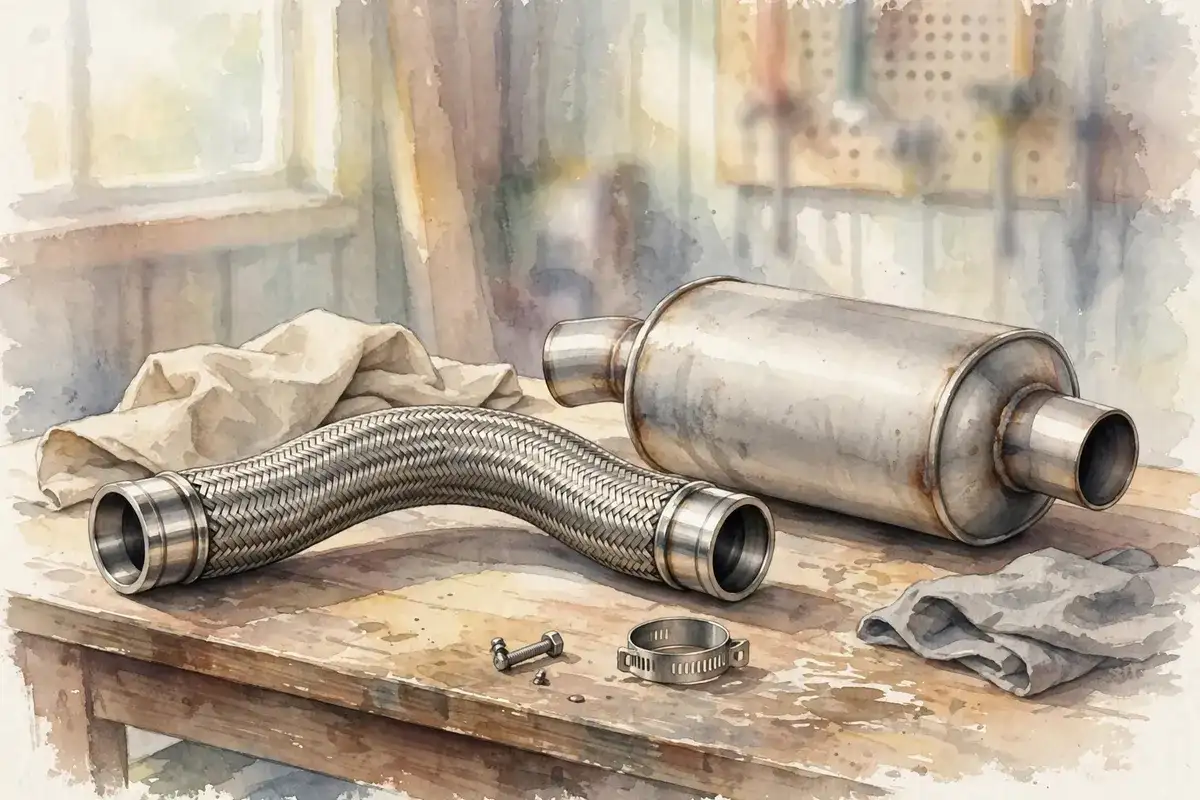
Three different noises come out of the middle of the exhaust, and each one points at a different part and a different bill. A loud, raspy roar that gets worse when you accelerate is usually the flex pipe. A deep drone at highway speed that was not there last month is usually the resonator. A steady hiss or a rattle from underneath, with the car slowly getting louder week by week, is usually a rusted pipe section. The parts sit side by side under the car, they fail for the same reason, road salt, and they are often quoted together, so the first skill is knowing which one you are actually paying for.
The flex pipe is the braided, flexible section near the front of the system, and it does a job no other part does: it absorbs engine movement so the rest of the exhaust does not crack every time the engine rocks on its mounts. It flexes thousands of times, it sits low where it takes salt spray and stone hits, and on many cars it is the most common failure in this section. EngineerFix puts a welded-in universal flex pipe at $150 to $350 total in US dollars, and a bolt-on direct-fit replacement at $350 to $600, with the direct-fit assembly itself at $150 to $400 or more because it includes the flanges and bends. CarTreatments gives a similar picture for 2026: $150 to $400 for most vehicles, with the part itself at $30 to $80 and labour at $120 to $320, and $500 to $700 or more where the flex pipe is built into the catalytic converter or the car is a luxury model. In Canadian dollars, with Canadian labour rates, a straightforward flex pipe job on a mainstream car typically lands at $220 to $500, and the table below uses Canadian-dollar estimates cross-checked against those US figures. A cracked flex pipe leaks exhaust gas, including carbon monoxide, under the car, and it is not a part to patch with exhaust tape for long; tape is a roadside stopgap, and a proper replacement is the fix.
A straight exhaust pipe section is the simplest job of the three. GB Times puts replacement pipe sections at $50 to $200 for the part in US dollars, and with an hour or so of cutting and welding the Canadian installed total typically runs $250 to $550 for a standard car. The trap is not the pipe, it is the pipes on either side of it: on a badly rusted system, replacing one section while its neighbours are paper-thin just moves the next failure a few months down the road, and a complete mid-section in stainless steel can be better value than three separate mild-steel repairs spread over a year. A good exhaust shop will inspect the whole system on the hoist and tell you honestly whether one section or the whole mid-pipe needs doing, and if the quote says exhaust repair as a single line with no breakdown, ask for it itemized by section.
The resonator is the part drivers misunderstand most. It looks like a small muffler, and it is often mistaken for one, but its job is different: it tunes out drone and vibration, the low-frequency hum that makes a car tiring on the highway, while the muffler does the main job of quieting the exhaust. GB Times puts a replacement resonator at $50 to $150 for the part in US dollars, and the Canadian installed total typically runs $260 to $550 for a standard car. Its failure is subtle, a drone at highway speed or a rattle from a broken internal baffle, and many drivers live with it for months. That is usually harmless, but a failed resonator can also be the first visible sign that the whole mid-section is rusting out, so treat it as a prompt to inspect the rest of the system, not just the noisy part. One warning: deleting the resonator to change the sound, instead of replacing it, costs $75 to $300 for a basic professional job according to EngineerFix, but it changes the exhaust note permanently and can make the car drone at cruising speed, so it is a modification, not a repair, and it is not a way to save money on a rusted system.
So here is the decision rule for the whole mid-section. If the flex pipe is cracked, replace it properly, welded or bolt-on, and do not accept tape as a repair. If one pipe section is rusted through, check the sections on either side before approving a single-section fix, because rust does not stop at the clamp. If the resonator drones, replace it, but ask the shop to check the flex pipe and the muffler at the same time, since they age together. And on any car you plan to keep through several more salted winters, ask the price difference for stainless steel: it costs more now and can be the last mid-section the car ever needs. If the muffler is also on the quote, read Muffler Replacement Cost in Canada first, and if the leak is at the front of the system where the exhaust meets the engine, the problem may be the manifold gasket instead, which is covered in Exhaust Manifold Gasket Replacement Cost. Before you approve, run the total through the RepairPrice calculator (calculator.php) and make sure every section is listed separately, because an exhaust repair as one vague line can hide a one-pipe job priced as a full system.
In Quebec shops you will hear the front pipe called the tuyau avant and the middle section described plainly as the intermediate section. If a quote lists parts you do not recognize, ask the shop to point at each one under the car; a shop that will not do that is a shop to walk away from. The other question worth asking is whether the quote is for a weld-in universal part or a direct-fit assembly, because the direct-fit part costs more but fits exactly and usually carries a better warranty, while a weld-in universal is cheaper and depends entirely on the welder's skill.
Common questions:
Q: What does a bad flex pipe sound like? A: A loud, raspy exhaust that gets worse under acceleration, according to CarTreatments, often with a rattling or hissing noise from under the front of the car. It is the most common flex pipe symptom, and it usually appears suddenly when the braid cracks.
Q: Can you drive with a bad flex pipe? A: A short drive to a shop is usually possible, but a cracked flex pipe leaks exhaust gas, including carbon monoxide, under the car, so do not put it off, and do not drive with fumes entering the cabin. Exhaust tape is only a roadside stopgap, not a repair.
Q: Is a flex pipe the same as a resonator or a muffler? A: No. A flex pipe manages movement and vibration, while resonators and mufflers reduce sound. The flex pipe absorbs engine movement, the resonator tunes out drone, and the muffler does the main quieting, so they are three different parts with three different prices.
Q: How much does a resonator delete cost? A: A professional resonator delete typically costs $75 to $300 for a basic installation, according to EngineerFix, depending on the shop's labour rate and the complexity of the exhaust layout. It is a sound modification, not a repair, and it can make the car drone at highway speed.
| Component (car) | Typical range | What moves the price |
|---|---|---|
| Exhaust pipe section | $250–$550 | Parts $75–$300, ~1.5 hours labour |
| Flex pipe | $220–$500 | Parts $80–$250, ~1.5 hours labour |
| Resonator | $260–$550 | Parts $120–$300, ~1.5 hours labour |
| Same parts, SUV/truck | $280–$650 | Larger diameter, dual systems |
| Same parts, luxury | $350–$800 | Factory parts, complex routing |


 RepairPrice
