
EVAP System Leak: Repair Cost in Canada
By Oleksandr Potapenko · 2026-11-16 · How we research prices
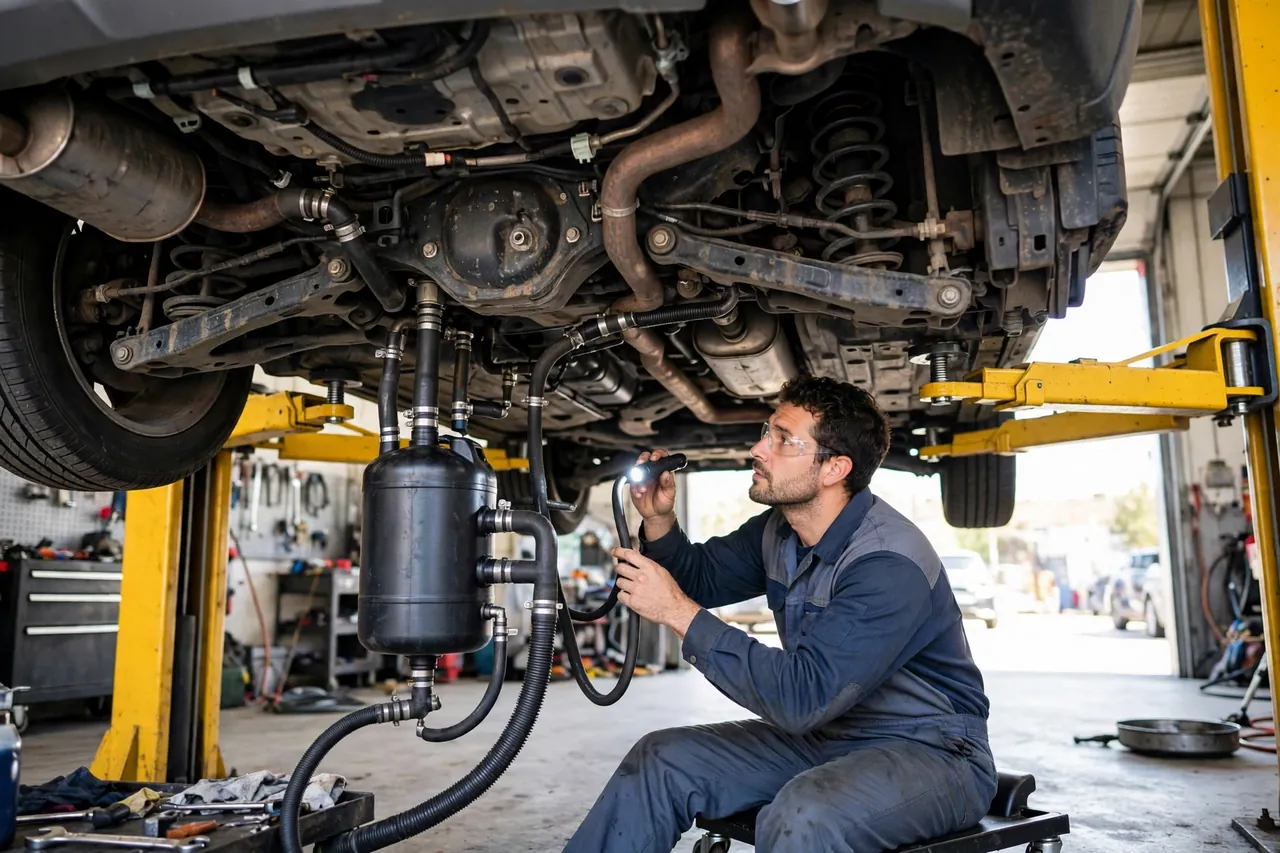
The code is not the diagnosis. That is the one sentence that saves EVAP owners the most money, and it is worth understanding before a single dollar is spent. When the check-engine light comes on with an EVAP code, the car's computer is reporting the size of the leak it measured, not the part that failed. A P0456 means a very small leak, about 0.020 inches; a P0442 means a small leak, about 0.040 inches; a P0455 means a large leak; a P0441 means incorrect purge flow; and a P0457 is the code that points most directly at the fuel cap. The same loose cap can produce any of them depending on how loose it is, and a cracked hose can look exactly like a failed valve. The code narrows the search. It never names the part.
The EVAP system exists for one reason: to stop fuel vapour from escaping into the air. It seals the fuel tank, stores vapour in a charcoal canister, and meters it back into the engine to be burned. When any part of that sealed system leaks — a cracked hose, a failed purge valve, a tired seal — the car notices the pressure drop, turns on the check-engine light, and stores a code. The car usually drives perfectly normally, which is why so many drivers ignore the light for months. The problem is that a small EVAP leak is also the most common reason a car fails an emissions test, and in provinces with emissions testing that failure is a registration problem, not a curiosity. In Ontario, for example, Drive Clean still applies to some vehicles, and an unresolved EVAP code is the classic reason a car that runs fine still fails.
The order of operations is what keeps this repair cheap, and the order is: cap, code, smoke test, parts. First, the cap. Tighten it until it clicks, drive for a few days, and see if the light goes out. A loose or cracked cap is the single most common EVAP fault — Steer, a diagnostic guide publisher, puts a loose or worn gas cap at roughly one in five EVAP-related codes — and it is also the only one you can fix in a parking lot. A replacement cap is cheap as a part: Steer puts it at $15 to $40 USD, and RepairPal's September 2026 estimate for a fitted gas cap replacement is $138 to $150 USD, which converts to roughly $195 to $210 CAD fitted. If the light stays on after a week of normal driving, the cap is not the problem.
Second, the code. A diagnostic scan at a Canadian shop runs $95 to $130 CAD and tells you which code you have, and a professional diagnostic at $100 to $180 CAD is the deeper version that is often credited toward the repair. Third, the smoke test — and this is the step that separates a $100 repair from a $1,000 guessing game. A smoke machine pushes low-pressure vapour into the system and shows the leak in about twenty minutes; Steer puts a smoke test at $80 to $150 USD, and EngineerFix puts it at $90 to $127 USD. The alternative is replacing parts in sequence — cap, then purge valve, then vent valve, then canister — which Steer prices at roughly $30, $200, $250 and $600 USD, or over a thousand dollars spent to find a $12 hose. The smoke test is the cheapest money in the whole EVAP family, because the code never says where the leak is.
What the smoke test finds decides the bill, and the published numbers line up well across sources. RepairPal's September 2026 estimates, as compiled by CarParts.com, put a purge valve replacement at $210 to $251 USD — about $295 to $350 CAD — and a charcoal canister replacement at $558 to $643 USD, about $780 to $900 CAD. Steer's wider ranges put a purge valve at $100 to $250 USD fitted, a vent valve at $100 to $300 USD, a cracked hose at $50 to $200 USD, and a canister at $300 to $700 USD. EngineerFix puts the canister at $524 to $608 USD on most vehicles, and warns that if the canister is mounted where the tank has to be dropped, labour can push the total past $1,000 USD. The pattern is consistent: hoses and valves are modest jobs, the canister is the expensive end, and access is what turns a $500 part into a $1,000 bill. A purge valve stuck open also causes a rough idle and hard starting right after a fill-up, which is a useful clue — if the car stumbles specifically after refuelling, the purge valve moves to the top of the list.
Two things most drivers never hear about EVAP repairs are worth knowing. First, the cause is often the driver: a canister rarely fails on its own, and the most common way to kill one is topping off the tank past the first click, which floods the charcoal with liquid fuel. CarParts.com, GearPuff and EngineerFix all make the same point — repeated overfilling saturates the canister and destroys it. Stop at the click and the canister lasts the life of the car. Second, the repair may be free. Under the federal emissions warranty, most emissions-related parts are covered for two years or 24,000 miles, and the catalytic converter and the powertrain control module for eight years or 80,000 miles — and the purge valve, the vent valve, the charcoal canister and the tank pressure sensor are emissions parts on essentially every car sold in North America, which means on a two-year-old vehicle this repair may cost you nothing at a dealer. Check the warranty before you pay a shop.
The decision rule, then, is simple and in this order: tighten the cap and wait a week; get the code read; pay for the smoke test before authorising any part; and ask whether the repair is covered under the emissions warranty. A shop that wants to replace the canister before the hoses have been checked is a shop to walk away from. For a model-specific price, run your car through the RepairPrice calculator (calculator.php) and compare the result with the written quote. If the light turns out to be the cap alone, the companion guide Loose Gas Cap and the Check Engine Light: What to Do walks through the reset in detail, and if the fault is deeper in the fuel system, Fuel Pump and Fuel Filter Replacement Cost and Fuel Injector Replacement and Fuel System Cleaning Cost cover the parts that feed the EVAP system in the first place.
Common questions:
Q: Can I drive with an EVAP leak? A: Usually yes — the car drives normally, and an EVAP leak is an emissions fault, not a safety fault. But it will fail an emissions test, it wastes fuel vapour, and a stuck-open purge valve can cause a rough idle and hard starting after refuelling. Fix the cap first, then get the code read; do not ignore it for months.
Q: How much does it cost to fix an EVAP leak? A: It depends entirely on the part. A replacement cap is $15 to $40 USD as a part, or about $195 to $210 CAD fitted per RepairPal. A purge valve is $210 to $251 USD on RepairPal's September 2026 estimate, a vent valve $100 to $300 USD, a hose $50 to $200 USD, and a charcoal canister $558 to $643 USD. A smoke test at $80 to $150 USD is what keeps you from replacing parts in the wrong order.
Q: What is a smoke test and do I need one? A: A smoke machine pushes harmless low-pressure vapour into the sealed EVAP system and the technician watches where it escapes — a crack in a hose or a seal that no eye can see. It takes about twenty minutes and costs $80 to $150 USD. You need one whenever the code does not point at the cap, because the code reports the size of the leak, never its location.
Q: Will an EVAP leak fail an emissions test? A: Yes. A small EVAP leak is the most common reason a car fails an emissions test, and the check-engine light alone is a failure in most test regimes. Clear the cap fault, drive at least a week so the EVAP monitor can run and confirm the repair, and only then book the test — clearing a code with a scanner also resets the readiness monitors, which is itself a failure.
| Service | Typical range (CAD) | Notes |
|---|---|---|
| Tighten the gas cap | $0 | Until it clicks; wait a week of normal driving |
| Replacement gas cap, fitted | $195–$210 CAD | RepairPal Sept 2026: $138–$150 USD; part alone $15–$40 USD |
| Diagnostic scan | $95–$130 CAD | Reads the exact EVAP code: P0442, P0455, P0456, P0457 |
| Smoke test | $110–$210 CAD | Steer $80–$150 USD; finds the leak in ~20 minutes |
| Purge valve replacement | $295–$350 CAD | RepairPal Sept 2026: $210–$251 USD |
| Vent valve replacement | $140–$420 CAD | Steer $100–$300 USD fitted |
| Cracked EVAP hose | $70–$280 CAD | Steer $50–$200 USD; access decides the labour |
| Charcoal canister replacement | $780–$900 CAD | RepairPal Sept 2026: $558–$643 USD; over $1,000 USD if tank must drop |


 RepairPrice
