
EV Home Charger Installation Cost
By Oleksandr Potapenko · 2026-11-16 · How we research prices
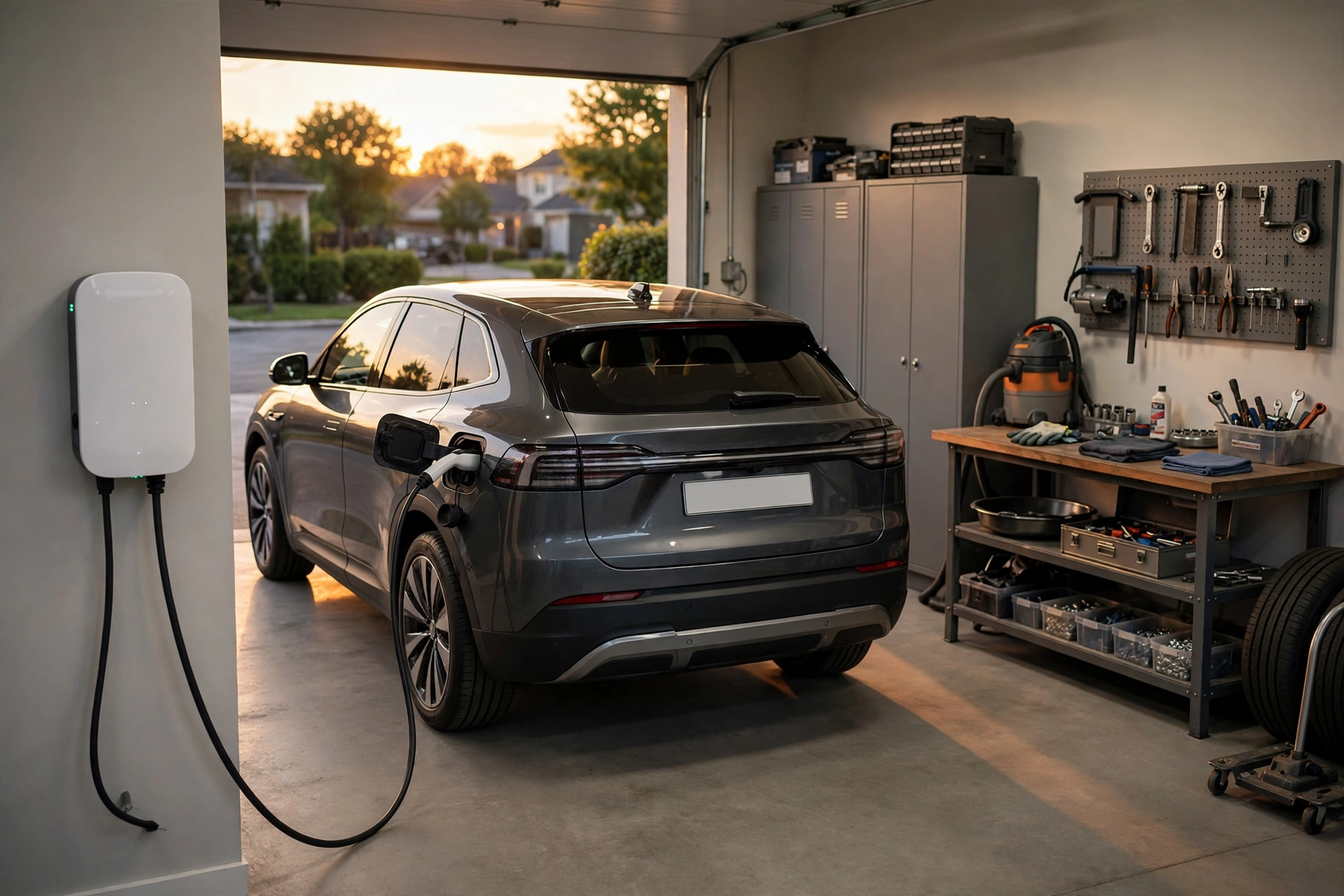
The charger is the cheap part. The panel is the expensive question. A quality Level 2 charger costs $300 to $700 in the US, and Qmerit's 2026 installation data puts the average Level 2 project at $1,700, with most projects between $749 and $2,500, charger included. That average breaks down to about $800 for the charger, $600 for electrician labour and permitting, and $300 for materials. But the number that surprises people is the one that sits outside the average: a panel or service upgrade to 200 amps adds $1,500 to $3,000, according to Qmerit, and Lawrence Berkeley National Laboratory's August 2026 report, based on a survey of building-industry professionals, puts the median main panel replacement at $3,500, with the middle half of jobs between $2,100 and $5,000, and the median service upgrade at $2,800. The first question to answer is not which charger to buy. It is whether your panel has room for a 40 to 60 amp circuit.
Start with the panel, because it decides the whole job. A Level 2 charger needs its own dedicated 40 to 60 amp circuit, and a house with a 200-amp panel and spare capacity is a straightforward install: 2 to 4 hours, a short wire run, a permit, and you are done. A house with a 100-amp panel already near capacity is a different job. The options are a full panel or service upgrade at $1,500 to $5,000, or a load management device at $300 to $800, which throttles the charger when the house is using power elsewhere and is often the cheaper alternative. In Canada, the same logic applies: a standard install runs $1,000 to $3,000 all-in, a panel upgrade from 100 to 200 amps runs $1,500 to $4,000, and a load management device runs $1,000 to $1,200. ThinkEV's 2026 Canadian guide puts a hardwired Level 2 charger at $1,200 to $2,500 installed in most Canadian metros, before rebates. The distance from the panel to the charger is the second cost driver: a panel in the garage with a run under 25 feet is cheap, a panel on the opposite side of the house with a 60-foot run or a detached garage that needs trenching adds $500 to $2,000.
The rebates are real but uneven, and one of them just disappeared. In Canada, BC Hydro offers up to $350, covering 50 percent of eligible costs, and Quebec's Roulez Vert program offers up to $600 for purchase and installation. Ontario, Alberta, and Saskatchewan have no active provincial rebate in 2026, and there is no federal home-charger rebate. In the United States, the federal 30C tax credit, which covered 30 percent of home charger equipment and installation up to $1,000, expired for equipment placed in service after June 30, 2026, under the 2025 tax law. Some installer marketing pages still reference the credit, and they are out of date. What remains in the US is a patchwork of utility rebates: 23 states still offer them in 2026, according to a review of 67 real Qmerit quotes, and they are claimed after installation, not before. Check your utility's program page before you budget, and do not let a quote subtract a rebate you have not confirmed.
EnergySage's 2026 analysis, based on Qmerit data, adds a useful second opinion that disagrees with Qmerit's headline in an instructive way. EnergySage reports an average installation cost of approximately $2,442 before the charger itself, against Qmerit's $1,700 average with the charger included. The gap is not an error; it is a scope difference. Qmerit's average covers standard installations, while EnergySage's average includes more complex jobs with longer runs and panel work. A review of 67 real homeowner quotes collected between January and March 2026 lands between them: a national average of $1,562, with a standard install at $0 to $1,350, a moderate install at $1,200 to $1,900, and a complex install at $1,900 to $2,800, before any panel upgrade. The practical lesson is to get three quotes from licensed electricians, because the range for the same house can span more than $1,000 between installers, and the average American homeowner in that review saved $467 by comparing Qmerit against two or three local electricians.
The charger choice itself is simpler than the install. A 32 to 48 amp unit is the right size for most cars and most panels; a higher-amperage charger is wasted if your car cannot accept it or your panel cannot feed it. Tesla lists its Wall Connector at $585 and its Universal Wall Connector at $660 after a September 2026 price rise. A plug-in charger on a NEMA 14-50 outlet is cheaper to install than a hardwired unit and can be taken with you if you move, but a hardwired unit is cleaner and is required above 40 amps in many jurisdictions. Smart features matter if your utility has time-of-use rates: scheduling the charge for overnight off-peak hours is where the real savings live, since Ontario's ultra-low overnight rate is only a few cents per kilowatt-hour and Quebec's first tier is 6.4 cents. Get the installation quote before buying the charger, since the install can cost more than the hardware, and never DIY a 240-volt circuit. For the running costs once it is in, see EV Charging Costs in Canada: Home vs Public, and for the battery it charges, EV Battery Degradation: What It Costs and How to Slow It. Run any quote through the RepairPrice calculator (calculator.php).
Common questions:
Q: How much does it cost to install an EV home charger? A: In the US, Qmerit's 2026 average is $1,700 with the charger included, most projects between $749 and $2,500, while EnergySage's average is about $2,442 before the charger. In Canada, a standard install runs $1,000 to $3,000 all-in. A panel upgrade adds $1,500 to $5,000 on top in either country.
Q: Do I need a panel upgrade for an EV charger? A: Only if your panel has no capacity for a dedicated 40 to 60 amp circuit. A 200-amp panel with spare capacity is a straightforward install. A 100-amp panel near capacity needs either a full upgrade at $1,500 to $5,000 or a load management device at $300 to $800 in the US, or $1,000 to $1,200 in Canada.
Q: Is there still a tax credit for a home EV charger? A: In the US, no: the federal 30C credit expired for equipment placed in service after June 30, 2026. In Canada, BC Hydro offers up to $350 and Quebec's Roulez Vert up to $600; Ontario, Alberta, and Saskatchewan have no active provincial rebate in 2026.
Q: Should I get a hardwired or plug-in charger? A: A plug-in charger on a NEMA 14-50 outlet is cheaper to install and portable, while a hardwired unit is cleaner and required above 40 amps in many jurisdictions. Get the installation quote before buying the charger, since the install can cost more than the hardware.


 RepairPrice
