
Engine Rebuild vs Replace: The Decision in Canada
By Oleksandr Potapenko · 2026-11-16 · How we research prices
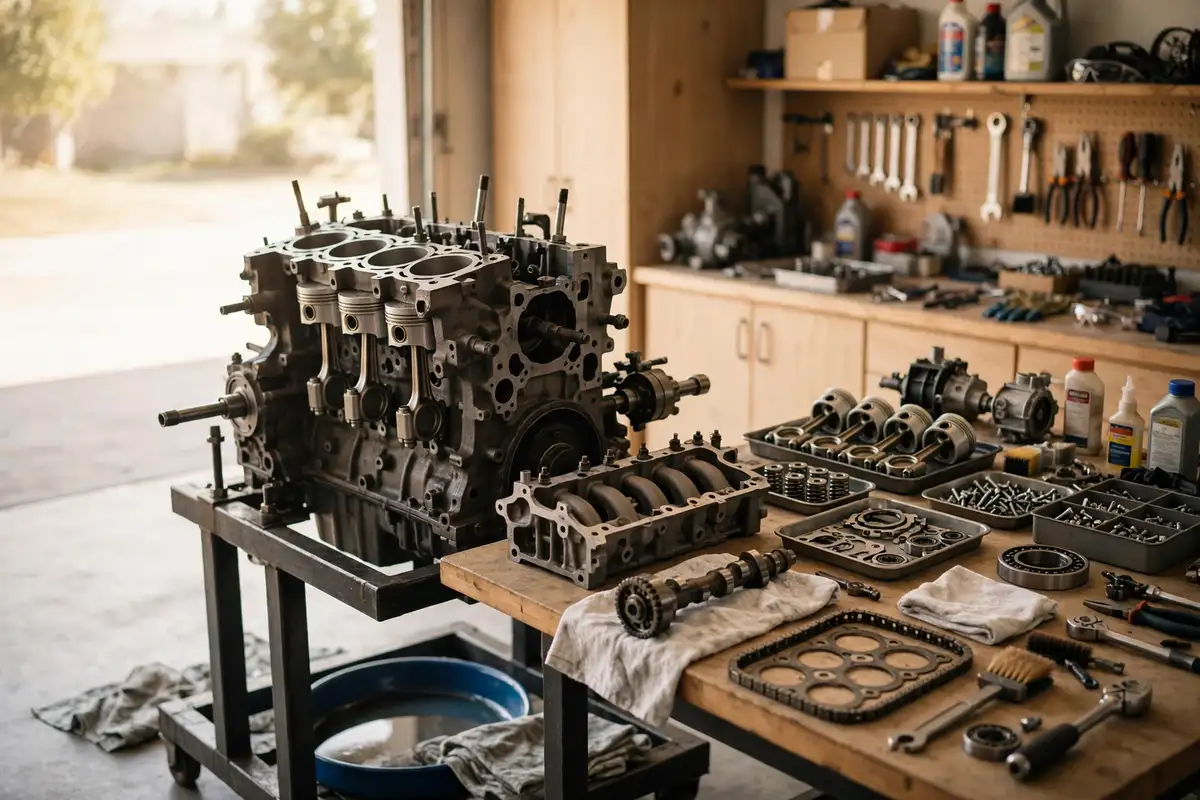
The decision rule comes first, because everything else in this guide is just arithmetic around it. If the repair costs more than about half of what the car is worth, compare the repair against selling the car as-is and replacing it. That is the 50 percent test that AAA uses, with the car's value set by Kelley Blue Book (KBB) or Edmunds, and it is the only rule that survives contact with a real quote. A $6,000 engine in a car worth $5,000 only makes sense if the rest of the car, transmission, body, suspension, is solid and you plan to keep it for years. A $6,000 engine in a car worth $12,000 with a clean body is usually a good investment. Write the car's value down before you get the quote, because once a shop has your engine apart, the pressure to say yes grows with every phone call.
When an engine is worn out or badly damaged, you face three paths. A rebuild means the shop strips your engine, machines the worn parts, and reassembles it with new bearings, rings, gaskets and seals. A used engine is a complete unit from a wrecked car, installed as-is. A remanufactured engine is rebuilt to factory specifications in a dedicated facility, with new wear parts throughout. Price sets the frame. A major engine rebuild on a typical car runs roughly $3,875 to $6,750 at an independent shop, based on $1,500 to $3,500 of parts plus about 25 hours of labour; SUVs run about $4,455 to $7,760 and luxury models about $5,230 to $9,110, which lines up with Greenway Auto Recycling, a Canadian guide that puts a rebuilt engine replacement at $4,000 to $7,000 Canadian. A used engine installed is usually cheaper than a rebuild, but its history is unknown, and you may be buying someone else's worn engine: WarrantyChick, another Canadian guide, puts a used salvage engine installed at $4,000 to $7,000 Canadian, against $8,000 to $13,000 Canadian or more for a remanufactured or new crate engine. A remanufactured engine typically costs more than a used one but comes with a real warranty, often several years, which matters when the labour to install it is itself a large bill. In the United States, the same choice looks like this: a used engine installed at $1,500 to $6,000, a remanufactured engine installed at $4,000 to $8,500, and a new crate engine installed at $5,000 to $12,000 or more, with labour alone at $1,500 to $3,500. EngineerFix puts the same American choice lower, with total replacement for a standard vehicle at $4,000 to $7,000 US and a rebuilt unit at $2,500 to $4,000 US before installation labour, so the wider bands above cover larger engines and luxury models. Canadian figures run higher in dollars, and Greenway puts a full engine replacement at $3,000 to $10,000 Canadian or more depending on the car, with a new engine at $6,000 to $10,000 or more, which is the range to use when the shop quotes a swap rather than a rebuild.
Warranty is where the three options truly separate, and it is the part owners underweight. A used engine typically gets 30 to 90 days, parts only. A remanufactured unit usually carries 3 years or 100,000 miles. A new OEM crate carries about 3 years with a full factory warranty. On a job where the labour to install the engine is itself $1,500 to $3,500, paying the labour twice because a cheap used engine failed wipes out any saving from the cheapest option. That is why the remanufactured engine is the best value for a keeper car, the used engine is the right choice only when the budget is tight and the car is older, and the rebuild makes sense when the engine is a known quantity, a rare engine, or one where a swap is impractical. A seized engine or a thrown rod is a replacement-only failure; no rebuild fixes that reliably, and a shop that offers to rebuild a thrown-rod engine should be asked exactly what is being replaced.
Start with the car's overall condition, not the engine alone. A rebuild or reman makes sense when the body is solid, the transmission is healthy, and the rest of the car has years left, because you are investing in a car you know. If the body is rusted, the transmission is slipping, and the suspension needs work, the engine is just the biggest item on a long list, and the money may be better put toward a replacement car. Also consider downtime: a rebuild keeps your car in the shop for days or weeks, while a used or reman swap is usually faster, often a week or two including sourcing the engine. Whatever path you choose, get the failure's cause fixed at the same time. An engine that died from overheating needs the cooling system sorted, and one that died from oil starvation needs the oiling problem found, or the replacement engine dies the same way. The cooling-system story is covered in Head Gasket Repair Cost in Canada, and the oil story in High Oil Consumption: Causes and Repair Cost in Canada and Oil Pressure Warning Light: Causes and Repair Cost. Get every option quoted in writing with the warranty spelled out, and check the fair price for your exact car on the RepairPrice calculator (calculator.php) before you commit.
Common questions:
Q: Is it better to rebuild or replace an engine? A: A remanufactured engine is usually the best value for a car you plan to keep, because it carries a 3-year or 100,000-mile warranty. A rebuild makes sense for a rare engine or one you know well. A used engine is cheapest but carries only a 30 to 90-day parts warranty and an unknown history.
Q: How much does an engine rebuild cost in Canada? A: Roughly $3,875 to $6,750 for a typical car at an independent shop, $4,455 to $7,760 for an SUV, and $5,230 to $9,110 for a luxury model. A full engine replacement in Canada runs $5,000 to $15,000 or more depending on the car (Greenway: $3,000 to $10,000 or more; WarrantyChick: $8,000 to $13,000 or more for a remanufactured or crate engine).
Q: How long does an engine replacement take? A: A straightforward swap books 8 to 15 hours of shop time, but sourcing the engine and the queue at a busy shop usually mean the car is off the road for a week or two. A rebuild takes longer, often several weeks.
Q: Does insurance cover engine replacement? A: Standard car insurance does not pay for engine replacement caused by wear or mechanical failure, only for damage from a covered event like a crash or flood. A blown engine from overheating or low oil is an out-of-pocket repair.
| Option | Typical cost picture | Best when |
|---|---|---|
| Rebuild your engine | $3,875–$6,750, car | Body and transmission are solid; you keep the car |
| Used engine, installed | $4,000–$7,000 (WarrantyChick) | Budget is tight; car is older |
| Remanufactured engine | $8,000–$13,000+ (WarrantyChick) | You want warranty protection on a keeper |
| New crate engine, installed (USA) | $5,000–$12,000+ | Zero miles, full factory warranty |
| Full engine replacement, Canada | $5,000–$15,000+ | Greenway $3,000–$10,000+; WarrantyChick reman $8,000–$13,000+ |
| Sell or scrap the car | — | Rust + transmission + engine all failing |
| Fix the root cause too | Part of any option | Overheating or oil starvation caused it |




 RepairPrice
