
Catalytic Converter Replacement Cost in Canada
By Oleksandr Potapenko · 2026-11-16 · How we research prices
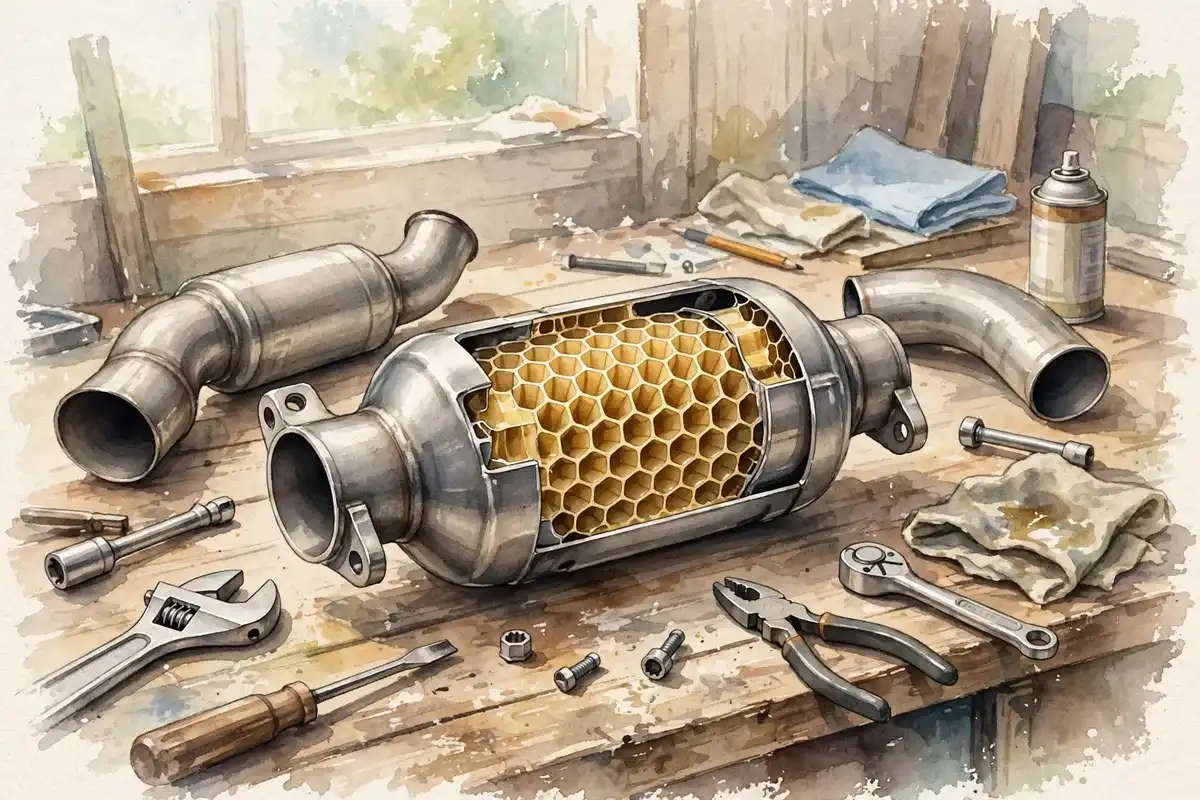
Replacing a catalytic converter in Canada typically costs $1,000 to $4,000 all-in, according to WarrantyChick's September 2026 Canadian guide, and that wide range is the first thing to understand, because it is not sloppy pricing. It is the difference between a small aftermarket converter on a sedan and a factory converter on a truck with two of them. If a shop quotes you a single number without saying which kind of converter it is, you do not yet have a quote you can compare.
WarrantyChick breaks the Canadian bill down like this: an original equipment (OEM) converter runs $1,500 to $3,500 for the part alone, an aftermarket direct-fit unit runs $400 to $1,200, and labour adds $150 to $600 for one to three hours of shop time. Its worked example of a typical Canadian repair lands at $1,500 to $1,750 out of pocket. RepairPal's US model estimates, in US dollars, show the same spread from the other side: a Toyota RAV4 is $674 to $764, a Toyota Tacoma $1,169 to $1,252, a Toyota Camry $1,872 to $1,950, a Toyota Corolla $2,039 to $2,103, a Toyota Highlander $2,136 to $2,428, a Toyota 4Runner $2,730 to $2,792, a Toyota Tundra $3,092 to $3,153, and a Toyota Sequoia up to $3,160 to $3,240. The RAV4 is cheap because it has one small converter; the Sequoia and Tundra are expensive because they have large ones, sometimes two. The two sources disagree on the exact top end because they measure different things, WarrantyChick pricing Canadian installed jobs in Canadian dollars and RepairPal pricing mostly near-OEM parts in US dollars, but they agree on the shape of the bill: the part is most of it, and the model decides the part.
Why does a box under the car cost as much as a used car? Because of what is inside it. A catalytic converter's honeycomb core is coated with platinum, palladium and rhodium, and those precious metals are the reason the part is expensive, the reason it is stolen, and the reason a cheap converter is a gamble. A universal converter, welded in by a muffler shop, is the cheapest route, but it must match your province's emissions specification, and a converter that is too small or the wrong spec will set the check engine light again within weeks. A direct-fit aftermarket unit is the sensible middle ground for most cars: it bolts in like the factory part, costs far less, and carries a warranty. The factory converter is the most expensive option and the right one on a nearly new car, a luxury car, or a vehicle with two converters where fitment is fussy.
Converters almost never die of old age alone. They are killed by what comes out of the engine: a misfire that dumps raw fuel into the exhaust, an engine running rich, burning oil, or a bad oxygen sensor. Raw fuel ignites inside the converter and melts the honeycomb, and oil coats the precious metals until they stop working. That is why the most important line in this guide is a rule, not a price: fix the cause before you fit the new converter, or the new one fails the same way, sometimes within months, and the warranty will not cover it, because the warranty covers the part, not the misfire that killed it. A good shop checks misfire codes, fuel trim readings and oil consumption before installing, and you should ask whether they did. If the underlying problem is a faulty oxygen sensor or a bad ignition coil, fixing that first is part of the converter job, not an extra, and our guide O2 and MAF Sensor Replacement Cost explains what that part of the bill looks like.
Theft is the other Canadian story, and it changes who pays. Converters are cut out for their precious metals, especially from trucks and SUVs that sit high enough to crawl under, and a stolen converter is the same $1,000 to $4,000 repair plus cut pipes and sensors. The claim usually goes through comprehensive insurance rather than your wallet, so check your deductible before paying out of pocket. Aftermarket anti-theft shields and cages, typically a few hundred dollars installed, are worth considering for a high-clearance vehicle parked outside overnight. And if your car was stolen from rather than broken down, get the police report number first, because the insurer will ask for it.
Before approving any converter quote, ask for three things: the diagnostic codes and the oxygen sensor readings that prove the converter is dead, what killed it, and whether the quoted part is OEM, direct-fit aftermarket or universal. A P0420 code, catalyst efficiency below threshold, does not always mean a dead converter; a lazy oxygen sensor can trigger it too, which is why the diagnosis matters more than the part number. If the quote lands well above the range in the table, get a second opinion, and use the RepairPrice calculator (calculator.php) to check the fair range for your exact year, make and model. A converter that is rattling inside, glowing red, or choking the engine of power is not a wait-and-see problem: a melted or blocked converter can overheat and damage the engine, and a flashing check engine light means an active misfire that is destroying the converter right now, so stop driving and get it towed.
Common questions:
Q: How long does a catalytic converter last? A: Most last 100,000 to 150,000 miles, according to TheMotorGuy and MyApexDriver, and a factory converter on a well-maintained car can last the life of the vehicle. Misfires, oil burning and coolant leaks can cut that to 50,000 miles, while quality aftermarket converters typically last 50,000 to 80,000 miles.
Q: Can you drive with a bad catalytic converter? A: It depends. A converter that has simply lost efficiency, with a steady light and no other symptoms, can usually be driven for a short time while you book the repair. A clogged converter that cuts power, or a flashing check engine light, means stop driving and get it towed, because restricted exhaust flow can overheat and damage the engine.
Q: Does insurance cover a stolen catalytic converter? A: Usually yes, under comprehensive coverage, minus your deductible, which is why you should check the deductible before paying out of pocket. Normal wear and failure are not covered; theft is.
Q: What does code P0420 mean? A: It means catalyst system efficiency below threshold on bank 1: the computer compared the oxygen sensors before and after the converter and found them too similar, so the converter is not cleaning the exhaust properly. It can mean a dead converter, but it can also mean a faulty oxygen sensor or an exhaust leak, so it needs a proper diagnosis before you buy a converter.
| Vehicle | Typical range | What moves the price |
|---|---|---|
| Standard car | $1,000–$2,400 | Parts $400–$1,500, 1–3 hours labour |
| SUV / truck | $1,400–$3,500 | Larger converters, dual systems |
| Luxury / European | $1,800–$4,500 | Factory converters, multiple units |
| Universal converter | Below direct-fit price | Cheaper, but must match emissions spec |
| Fix the underlying cause | Misfire / oxygen sensor / coil | Otherwise the new converter fails again |


 RepairPrice
