
Car Battery Keeps Dying: Parasitic Draw Diagnosis Cost
By Oleksandr Potapenko · 2026-11-16 · How we research prices
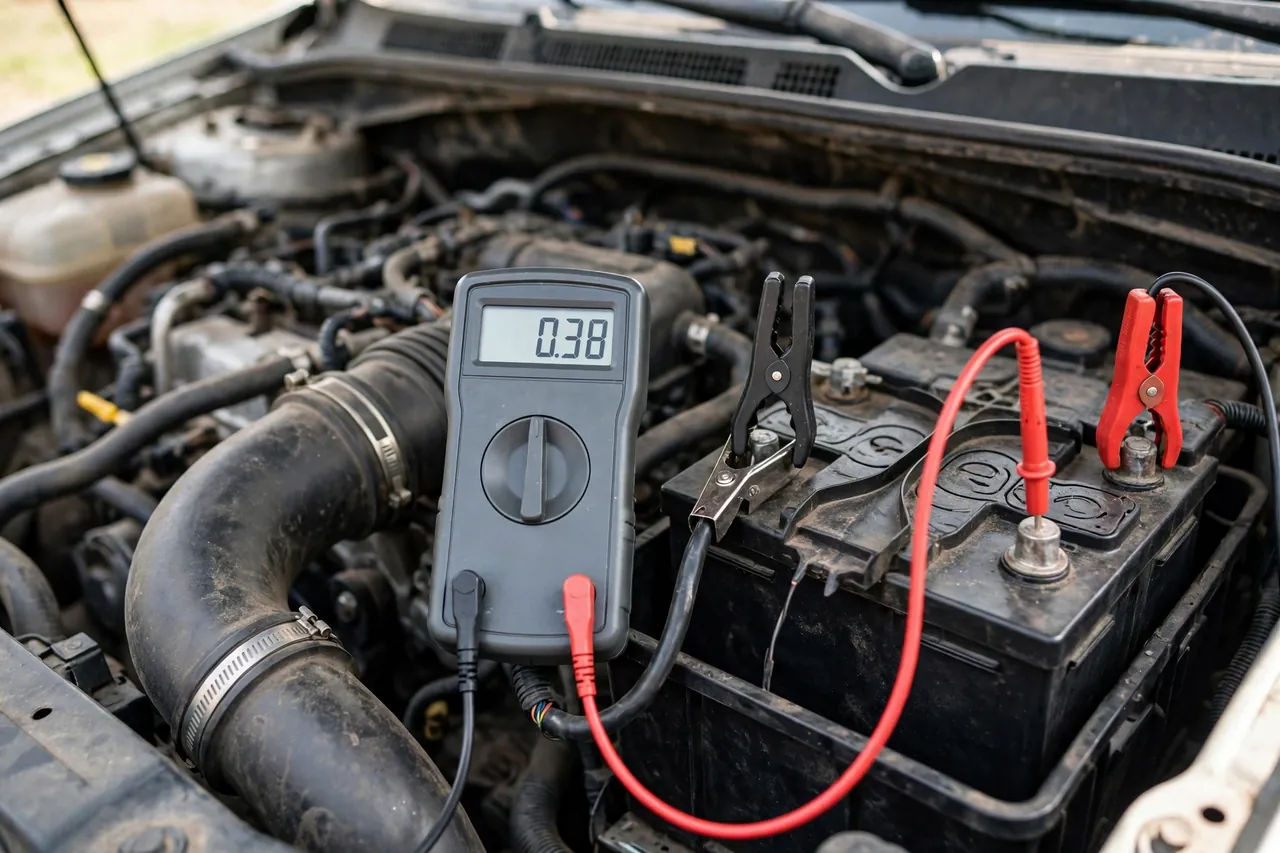
A woman in Calgary told her mechanic she had bought three batteries in eighteen months. Each one fixed the car for a few weeks, and each one died again. The fourth visit finally found the problem: a glove box light that stayed on when the lid closed, drawing current all night, every night. The repair was a $12 switch. She had spent more than $600 on batteries for a twelve-dollar fault, and that story is the whole reason this guide exists. A battery that keeps dying is usually not a battery problem at all, and every battery you buy without a diagnosis is a bet against the same odds.
A parasitic draw is any electrical load that keeps pulling current after the car is switched off and locked. A healthy modern car draws about 20 to 50 milliamps at rest — enough to keep the clock, the alarm, and the radio memory alive. Anything above roughly 50 milliamps after the car has fully gone to sleep is a real drain, and anything above 100 milliamps will kill a battery overnight. The usual suspects are unglamorous: a trunk or glove box light that stays on, a stuck relay, a door switch that does not register as closed, an aftermarket stereo, alarm, or dash cam wired to constant power, a failing alternator diode that leaks current backwards, or a control module — body control module, infotainment, amplifier — that refuses to go to sleep. TheMotorGuy's cost guide puts the same list in the same order, and notes that a stuck light switch is often under $40 to fix while a module that needs replacing can run $150 to $900 or more.
Before you pay for a diagnosis, rule out the two impostors. The first is the battery itself: AAA puts average battery life at three to five years, and a battery at the end of its life will go flat overnight with no drain at all. Get it load-tested first — most parts stores do it free in five minutes — and if it fails, a Canadian shop-installed battery typically runs $170 to $305 CAD, with Kelley Blue Book's US ranges for common cars at about $290 to $460 USD installed. The second impostor is the alternator: a failing diode inside the alternator can drain the battery when the car is parked and also fail to charge it while driving, so a charging-system test belongs before any drain hunt. In Canada an alternator typically runs $490 to $910 CAD at independent shops, while RepairPal's September 2026 US estimate is $809 to $1,088 USD — the gap is a reminder that the US figures convert higher and that dealer quotes run higher still. If the battery tests good and the alternator charges at roughly 13.8 to 14.4 volts with the engine running, then and only then is it a draw.
The professional diagnosis is a waiting game, and that is why it costs what it costs. The technician connects an ammeter in series with the negative battery terminal, locks the car, and waits — twenty to forty-five minutes — for every module to go to sleep before taking a reading, because a reading taken too early shows every module awake and proves nothing. Then comes the fuse-pull: with the meter still connected, fuses are pulled one at a time until the reading drops sharply, and the fuse that drops it names the circuit. Published guides put the shop diagnosis at $80 to $250 USD — TheMotorGuy quotes $80 to $150, EatHealthy365 quotes $100 to $250 for one to two hours of labour — which in Canadian shops typically works out to $110 to $250 CAD for the same one to two hours at $95 to $130 an hour. The honest conflict in those numbers is the point: a simple drain found in the first hour is cheap, and a multi-module fault that takes three or four hours is not, and no shop can tell you which one you have until the meter is connected. A shop that quotes a flat $50 for a drain diagnosis is quoting a code scan, not a draw test, and a code scan cannot find a drain.
You can do the first half of this yourself if you own a multimeter and are comfortable around a battery, and the savings are real. Set the meter to DC amps on the 10-amp socket, disconnect the negative terminal, connect the meter in series, lock the car, wait for sleep, and read the draw. Below 50 milliamps is normal; above 100 means keep going. Pull fuses one at a time and watch for the drop. Two warnings: never start the car or turn on the headlights with the meter in series on the amp setting, and never disconnect the battery on some modern cars without knowing whether it will need a radio code or a throttle relearn afterwards. If any of that sounds like a weekend you do not want, pay the shop — the $110 to $250 CAD diagnosis is cheaper than one unnecessary battery.
The decision rule is about sequence, not spending. Test the battery, test the charging system, then hunt the draw — in that order, every time. Do not buy a second battery before the first two tests, because a new battery masks a drain for a few weeks and then dies exactly the same way, which is how people end up buying three. When the shop finds the culprit, ask whether the fix is a part or a wiring repair, and ask for the draw reading before and after the repair in writing — a proper job ends with the car drawing under 50 milliamps asleep, and that number is your proof. For the battery itself, read Car Battery Replacement Cost in Canada; for the no-start picture, read Car Won't Start: Battery, Starter, or Alternator?; and if the car will not start in the cold specifically, read Car Won't Start in the Cold: Winter Causes and Fixes. Run the quote through the RepairPrice calculator (calculator.php) before you approve it, and remember the Calgary glove box: the cheapest repair on the car is often the one nobody has found yet.
Common questions:
Q: How much does it cost to diagnose a parasitic battery drain? A: Expect about $110 to $250 CAD in Canada for one to two hours of diagnostic labour. Published US guides quote $80 to $250 USD for the same work; the range reflects whether the drain is found in the first hour or takes three to four hours of module-by-module tracing.
Q: What is a normal parasitic draw? A: About 20 to 50 milliamps at rest, to keep the clock, alarm, and radio memory alive. Above roughly 50 milliamps after the car has fully gone to sleep is a real drain, and above 100 milliamps will kill a battery overnight.
Q: Can a bad alternator drain a battery overnight? A: Yes. A failing diode inside the alternator can leak current backwards when the car is parked. That is why a charging-system test belongs before any drain hunt — and why a new battery that dies within days points at the alternator first.
Q: Will a new battery fix a car that keeps dying overnight? A: Only if the old battery was the problem. If the battery tests good and the car still dies overnight, a new battery will die the same way in a few weeks. Test the battery and the charging system before buying another one.
| Service | Typical range (CAD) | Notes |
|---|---|---|
| Diagnostic scan | $95–$130 | Starting point; draw test billed as labour on top |
| Parasitic draw test, 1–2 hours | $110–$250 | US guides quote $80–$250 USD for the same work |
| Battery replacement, car | $170–$305 | First suspect if the battery is 4–5 years old |
| Alternator replacement, car | $490–$910 | Dead battery mimic — test charging first |
| Starter motor replacement, car | $370–$685 | Dragging starter looks like a dead battery |
| Stuck relay or light fix | $75–$205 | The most common culprits are cheap once found |


 RepairPrice
