
Car AC Recharge and Leak Detection Costs
By Oleksandr Potapenko · 2026-11-16 · How we research prices
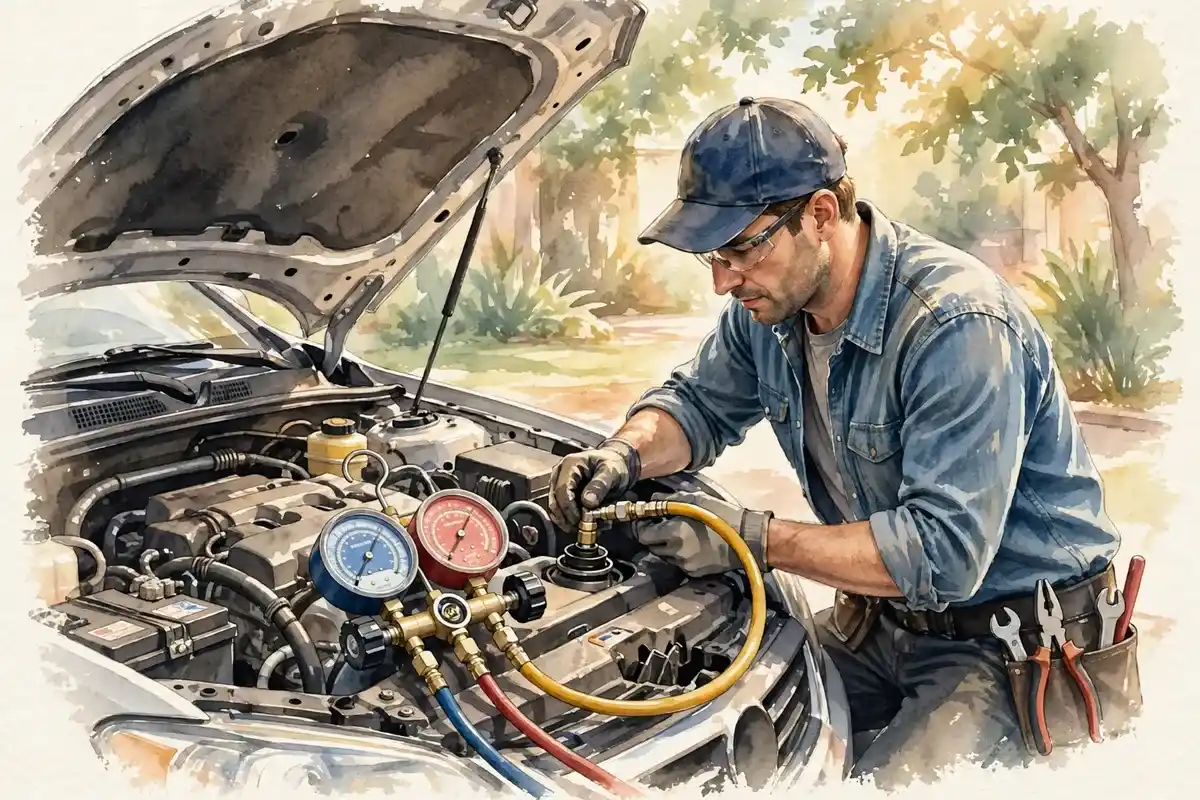
Here is the decision rule that saves most drivers money: a recharge is only a repair if the system holds it. Refrigerant is not fuel — a sealed air conditioning system never uses it up, so low refrigerant always means a leak, and a recharge without leak detection is a rental, not a fix. If the air conditioning faded slowly over weeks, pay for the leak test first. If it died overnight after a stone strike or a hose blew, skip straight to the repair. The one case where a recharge alone makes sense is a car that has never been serviced, is more than eight years old, and lost its cold gradually over two or three summers — a slow seep past old seals that a dye test may not even find.
BrokerLink, in its July 2026 Canadian guide, puts a refrigerant leak test plus recharge at $150 to $400 CAD, and iCash puts a simple refrigerant recharge at $150 to $300 CAD. Those two Canadian sources agree closely, and they line up with the American numbers once you convert them: RepairPal's United States estimator puts a recharge at $285 to $369 USD, which is roughly $400 to $515 CAD at about 1.40 Canadian dollars per US dollar, while ARI — which analysed 556,458 real invoices from 3,622 independent American shops between November 2025 and October 2026 — found a median recharge of just $183 USD, with the middle range at $132 to $300 USD. The gap between RepairPal and ARI is not an error. RepairPal prices the job the way a dealership or a well-equipped independent shop bills it, including a full evacuation, vacuum and refill by weight, while ARI's median reflects what independent shops actually invoiced, mostly on older R-134a cars that take the cheaper refrigerant. Expect the RepairPal end of the range on a newer car and the ARI end on an older one.
The refrigerant in your car is the single biggest price driver, and it is written on a label under the hood. Cars built before about 2015 mostly use R-134a, which HonestMechanix prices at roughly $3 to $8 per pound. Most cars from 2015 onward, and every new car since 2021, use R-1234yf, which the same source prices at roughly $40 to $80 per pound — five to ten times more. That is why a professional recharge runs $150 to $300 for an R-134a system and $250 to $500 for an R-1234yf system, and why a shop quote that does not name your refrigerant is not a quote yet. Fixxr adds a 2026 twist: the United States EPA's AIM Act phasedown cut R-134a production to 60 percent of baseline in 2024, pushing retail R-134a to $19 to $37 per pound by 2026, so even the "cheap" refrigerant is no longer cheap. In Canada, federal rules add another wrinkle BrokerLink flags: only certified technicians may recover and charge refrigerant, and shops are required to find and fix leaks rather than simply topping the system up.
Leak detection itself is a separate skill with three tools, and knowing them stops a shop from charging you twice. UV dye is the cheapest: the shop adds dye, recharges the system, and you come back in a few days so the leak glows under a UV light. An electronic sniffer finds leaks on the spot but can miss a slow one. A nitrogen pressure test is the most decisive for a leak that only shows up under pressure. BrokerLink puts diagnosis of a car air conditioning problem at around $200 CAD, and iCash puts the diagnostic fee at $80 to $150 CAD before any service begins — so if a shop quotes $200 for "diagnosis" and then another $200 for "leak detection" for the same visit, ask what the second fee buys. A small leak is often a worn O-ring or a loose fitting, a modest repair once found. A big leak usually means a failed hose, condenser or compressor seal, and those are separate, larger jobs — see our guides "Car AC Condenser Replacement Cost" and "Car AC Compressor Replacement Cost in Canada" before you approve anything.
Two warnings from the people who sell the parts. AutoZone notes that some newer R-1234yf systems take as little as six ounces of refrigerant, and overcharging one can cause catastrophic failure — so a do-it-yourself can with a cheap gauge is a gamble on a 2017-or-newer car. And a $9.99 evaluation coupon is not a recharge: Pep Boys lists evacuation and recharge from $75.24 before refrigerant, and AutoZone puts a do-it-yourself kit at $40 to $130 depending on refrigerant. If your air conditioning is weak in May, book before the first heat wave — ARI's invoice data shows air conditioning work runs about seven times busier in July than in January, and shops are least flexible on price when the queue is out the door. Use the RepairPrice calculator at calculator.php to sanity-check any quote against your year, make and model before you say yes.
Common questions:
Q: How long does an AC recharge last? A: A healthy sealed system should hold a recharge for years — five or more is normal. If the cold air fades within one summer, you have a leak that the recharge only masked, and the next step is dye or a nitrogen test, not another can of refrigerant.
Q: Can I drive with low refrigerant? A: Yes, for a while, but do not run the air conditioning on a system that is nearly empty. The compressor relies on refrigerant to carry its lubricating oil, and running it dry is how a $200 recharge becomes a compressor replacement.
Q: Is a DIY recharge kit worth it? A: On an older R-134a car, a $40 to $65 kit from AutoZone can work if you follow the gauge and do not overfill. On an R-1234yf car, or if you do not know which refrigerant you have, it is not worth the risk of mixing refrigerants or overcharging a system that holds only a few ounces.
Q: Why does my AC need a recharge every summer? A: Because the leak was never fixed. A system that needs an annual top-up is losing refrigerant through a seal, hose or condenser, and the honest fix is leak detection plus the repair — usually cheaper over two summers than two recharges.
| Job | Typical range (car) | What moves the price |
|---|---|---|
| AC recharge, R-134a | $150–$300 | Refrigerant $3–$8/lb, about 1 hour labour (HonestMechanix; iCash) |
| AC recharge, R-1234yf | $250–$400 | Refrigerant $40–$80/lb, 2015+ cars (HonestMechanix) |
| Leak detection | $145–$230 | UV dye or electronic sniffer, return visit |
| Leak test + recharge, bundled | $150–$400 | BrokerLink Canadian guide, July 2026 |
| Diagnosis only | $80–$200 | iCash $80–$150; BrokerLink about $200 |
| Recharge, SUV/truck | $180–$290 | Larger system, more refrigerant |
| DIY recharge kit | $40–$130 | AutoZone; R-1234yf kits cost more |


 RepairPrice
