
Bumper Cover Replacement Cost in Canada
By Oleksandr Potapenko · 2026-11-16 · How we research prices
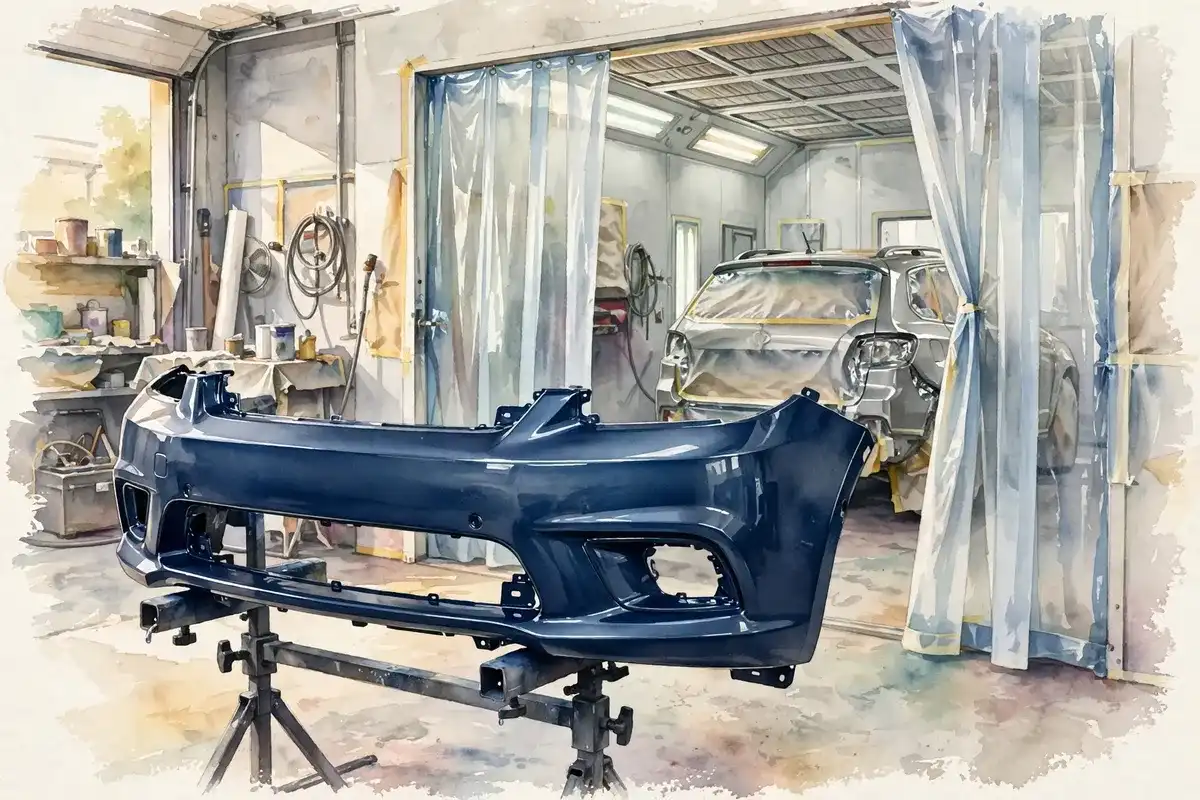
Is it a $200 cosmetic fix or a $2,000 replacement? That is the question Simplicity Collision Centres, a Canadian collision chain, says every bumper estimate really answers, and their five-tier framework is the clearest way to read your own quote. Tier 1, light scratches and scuffs, runs $50 to $300. Tier 2, dents with no paint damage, $150 to $500. Tier 3, deep scratches into the paint, $300 to $800. Tier 4, cracks and punctures, $400 to $1,200, sometimes saved by plastic welding if the crack is clean and the mounting tabs are intact. Tier 5, a full bumper cover replacement, $800 to $2,000, with labour of $200 to $500 and paint and refinish adding $300 to $600. Their real example: a driver in Oshawa, Ontario paid $1,299 for a full replacement and repaint after deep gouges made the original cover unsalvageable. Above that sits Tier 5-plus, a bumper with sensors and ADAS calibration, at $1,500 to $3,500 or more.
TDB Auto in North Vancouver, which specializes in European vehicles, lands in the same territory from the other side of the country. Their 2026 guide puts minor scratch repair at $150 to $600, major crack and structural work at $600 to $1,500, and full replacement at $800 to $3,000 depending on vehicle and sensor technology. Standard vehicles run $800 to $1,800 complete, luxury vehicles with driver-assistance systems reach $2,500 to $3,000 once OEM parts, specialized paint and sensor recalibration are counted, and a Tesla bumper replacement runs $1,800 to $3,000 because of unique paint formulations, extensive sensor integration and Autopilot hardware calibration. Parts alone cost $300 to $800 for standard vehicles and $600 to $1,500 for luxury ones. The two sources agree on the shape of the bill even though they disagree on the exact top end, and the disagreement is instructive: the top end is set by sensors, not by plastic.
That distinction, cover versus what sits behind it, is the most important thing to understand before you approve anything. The bumper cover is the painted plastic shell you see. Behind it sit the impact bar, the foam absorber and, on modern cars, parking sensors, radar modules and sometimes a camera. A low-speed bump that only scuffs the cover is cosmetic. The same bump can crack a sensor bracket or bend the impact bar without leaving much visible damage, and that is a safety repair, not a cosmetic one. A reputable shop removes the cover and inspects what is behind it before quoting, and a quote that skips that step is a quote that can grow by $500 after the cover comes off. Ask for the inspection in writing, and ask whether the estimate includes sensor transfer and recalibration or whether those are separate lines.
The repair-versus-replace decision follows a simple rule. If the damage covers less than about a quarter of the bumper surface, the paint is intact or only lightly scuffed, and the mounting tabs are unbroken, repair is usually the better buy: a plastic weld and repaint can cost half of a replacement and leaves the factory cover on the car. If the cover is cracked through, a mounting tab is snapped, the shape is distorted so the panel gaps are wrong, or a sensor mount is broken, replacement is the honest answer, and a repaired cover in that state will never sit right and may fail the next minor impact. On a car over eight years old that you plan to keep only a few more years, TDB Auto notes that an aftermarket cover saves 40 to 60 percent on the part cost, which is often the difference between fixing the car and living with the damage.
Insurance changes the math. A bumper claim goes through collision coverage, and Canadian deductibles commonly run $500 to $1,000, with ICBC in BC typically at $300 to $1,000. If the repair is $600 and your deductible is $500, claiming saves you $100 and costs you a claim on your record, which is a bad trade. If the job is $2,500 with sensor calibration, claiming is clearly right. A full replacement takes four to seven days including parts ordering, painting and sensor recalibration, so ask about a courtesy car or rental coverage before you drop the car off. And remember that a repainted bumper shows up on a vehicle history report, which matters at resale; a quality shop blends the paint into adjacent panels so the match is invisible, and that blending is part of what you are paying for.
Get two itemized quotes, one from an independent collision shop and one from a dealer-affiliated body shop if the car has sensors, and compare them line by line: cover part and source, paint and materials, labour hours, sensor transfer, and calibration. A quote that bundles calibration into one line is fine; a quote that omits it entirely on a sensor car is a quote that will grow. Check the related guide Paintless Dent Repair Cost in Canada if the damage is a dent with intact paint, and use the RepairPrice calculator (calculator.php) to check whether the total sits inside a fair range for your vehicle before you sign.
Common questions:
Q: How much does it cost to replace a bumper cover in Canada? A: Simplicity Collision Centres puts a full replacement at $800 to $2,000, and TDB Auto in North Vancouver quotes $800 to $3,000, with standard cars at $800 to $1,800 and sensor-equipped luxury cars at $2,500 to $3,000. A Tesla bumper runs $1,800 to $3,000. Minor repairs start at $150 to $600.
Q: Can a cracked bumper be repaired instead of replaced? A: Often yes, if the crack is clean and the mounting tabs are intact. Simplicity lists crack repair at $400 to $1,200 using plastic welding, versus $800 to $2,000 for a full replacement. If a tab is snapped, the cover is distorted or a sensor mount is broken, replacement is the right call.
Q: Why is my bumper quote so high when it is just plastic? A: Because the bill is mostly paint, labour and electronics, not plastic. TDB Auto breaks it down as $300 to $800 for the part, $200 to $500 for labour, $300 to $600 for paint and refinish, and $300 to $800 more for sensor recalibration on equipped cars. The cover itself is the cheapest part of the job.
Q: Should I claim a bumper repair on insurance? A: Compare the total to your deductible, typically $500 to $1,000 in Canada. A $600 repair against a $500 deductible is not worth a claim. A $2,500 sensor-equipped replacement almost always is. Also ask how long the shop needs the car: a full replacement takes four to seven days including paint and calibration.
| Vehicle | Typical range | What moves the price |
|---|---|---|
| Standard car | $800–$1,800 | Cover $300–$800, ~2.5 hours labour + paint $300–$600 |
| SUV / truck | $900–$2,000 | Larger cover, sensor transfer |
| Luxury / sensor-equipped | $1,500–$3,500 | Factory cover, sensor/camera recalibration $300–$800 |
| Repair instead of replace | $150–$800 | Sand and repaint, plastic weld, reshape |
| Hidden impact bar damage | $300–$800 extra | Safety repair, not cosmetic — check underneath |

 RepairPrice
