
Brake Line Replacement Cost in Canada
By Oleksandr Potapenko · 2026-11-16 · How we research prices
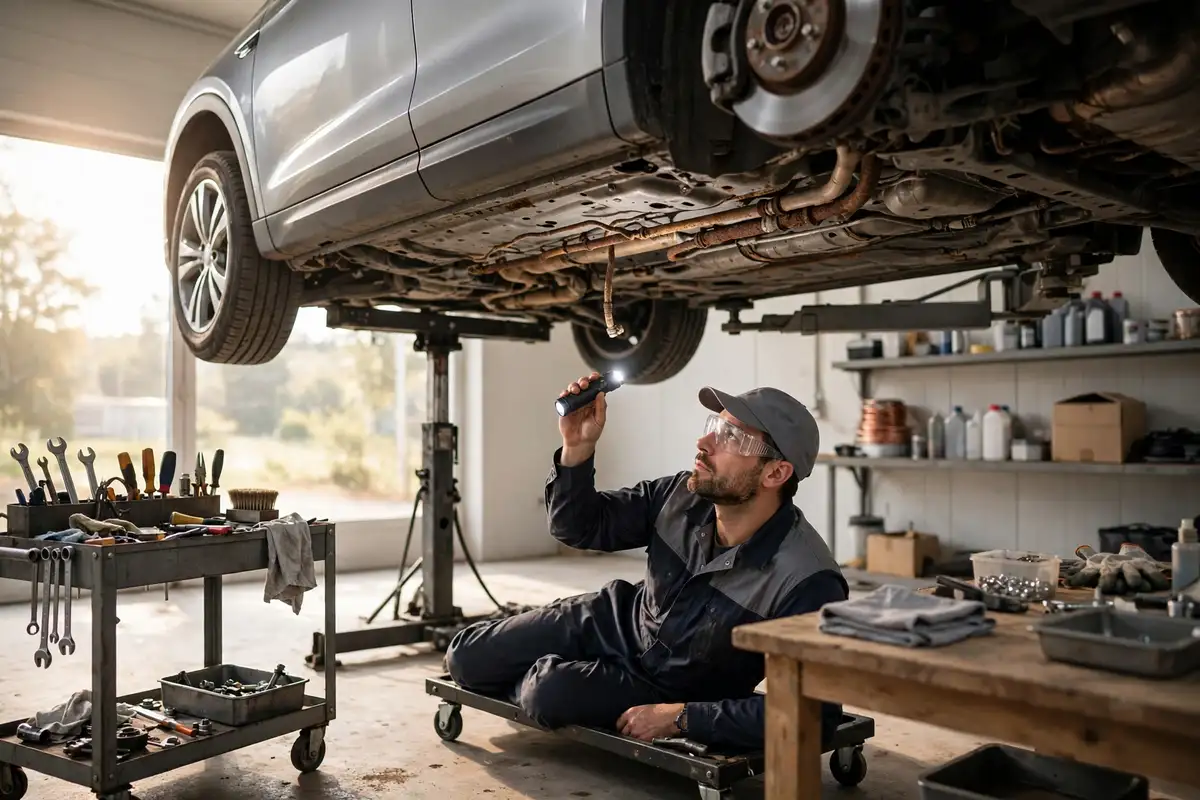
A brake line does not fail politely. It looks fine from the outside, it passes a glance under the car, and then one hard stop splits it open and the pedal drops toward the floor. That is the failure this guide is about, and it is the most Canadian brake repair there is. Factory steel lines run the length of the underbody, clipped to the chassis, and in Canada they rot from the outside in. Liquid magnesium and calcium chloride brine, the de-icers now spread on winter highways, seep into the chassis clips and cling to the metal far longer than old rock salt ever did. A line can look solid and be paper-thin inside a clip. Shops in the Prairies and Ontario see rusted lines far more often than shops in milder coastal areas, and a car that has spent ten winters on salted roads is a candidate whether or not it has shown a symptom yet.
The numbers depend on scope, and scope is where the confusion lives. Replacing a set of brake lines on a typical car runs roughly $270 to $460 at an independent shop, based on $80 to $200 of lines and fittings plus about two hours of labour at $95 to $130 an hour. SUVs and trucks run about $310 to $530 and luxury models about $365 to $620, mostly because longer runs and tighter routing add labour. That is the price for a set of lines, usually the corroded runs. But the published Canadian figures go wider, and the reason matters. A single short section, a flare splice, costs roughly $250 to $500 at an independent shop, according to WarrantyChick's October 2026 Canadian guide. A full vehicle replumb in copper-nickel, every hard line from the master cylinder to the wheel wells, runs $1,200 to $2,500. BrokerLink's Canadian guide puts a hard-line section at $250 to $600, and a Calgary guide puts line or hose repair at $150 to $500 and up, with one owner reporting a $700 quote for a complete job on a badly corroded Honda. These are not contradictions. They are different jobs: a section, a set, and a full replumb. The quote you get depends on how much of the system is rotten, and the only way to know is to have the car on a hoist and look.
The material decision is the one that pays for itself. Traditional steel lines are cheapest, and they are what the factory fitted, which is how you got here. Copper-nickel lines, often sold under the trade name NiCopp, cost more in parts but never rust, and they are easier to bend around rusted brackets, which saves labour on a corroded car. For a car you plan to keep through several more Canadian winters, copper-nickel is usually worth it. A full replumb in copper-nickel is the last brake-line job the car will ever need, and at $1,200 to $2,500 it is still cheaper than the second steel job, plus the tow, plus the safety inspection, that follows when the next section lets go. If you are selling the car within a year, steel is fine. If you are keeping it, ask for the copper-nickel price and compare honestly.
The symptoms are worth memorising, because the gap between the first symptom and the failure can be short. A puddle of clear-to-amber fluid near a wheel, or under the middle of the car, is brake fluid, and it is not a drip you monitor. A brake pedal that suddenly sinks to the floor, or a brake warning light that comes on, means pressure has been lost from one hydraulic circuit. The car has two circuits, so the other one still works, but stopping distances increase sharply and the pedal feels wrong. A line that is weeping will also show as a fluid level that keeps dropping in the reservoir with no visible leak at the wheels, because the leak is hidden above the fuel tank or inside a chassis clip. Do not drive a vehicle with a leaking brake line under any circumstances. Have it towed. A line that lets go can dump pressure from one circuit without warning, and the pedal may drop much further than you expect.
There is a temptation to patch a single short section and move on, and sometimes it is the right call. But many shops prefer to replace a full run, because patching a rusted line often just moves the next failure a few inches down the same corroded tube. Ask the shop to show you the section on the hoist. If the line is corroded in one place, look at the rest of it: if the corrosion is widespread, replacing the run is cheaper than returning three times for three patches. Corroded lines can also make a car fail an out-of-province inspection, so a patch that gets you through the month can still cost you the sale or the registration later.
Two practical protections matter. First, in Alberta, a licensed shop cannot exceed a written estimate by more than 10 percent, or $100, so ask for the estimate in writing before the work starts. Quebec is stricter still: garages must give you a written evaluation before repairs costing more than $100. Second, confirm the quote includes bleeding the whole system afterwards and a road test. Any line job that skips the bleed is unfinished, and the pedal will tell you so on the first stop. And check the warranty question before you pay: extended warranties and vehicle service contracts almost never cover rusted brake lines, because contracts specifically exclude damage caused by corrosion, rust, and salt. That exclusion is the norm, not an exception, so do not buy a contract expecting it to pay for this repair.
The decision rule: a leaking line is a tow, not a drive, and a corroded line is a replace, not a patch, unless the corrosion is genuinely local. Choose copper-nickel if you are keeping the car, steel if you are selling it, and a full run if the corrosion is widespread. And once the lines are done, protect the investment: an annual oil-based rust treatment runs $120 to $180, and preventing one rocker panel and one set of lines pays for eight years of treatments. Our guide Brake Fluid Flush Cost in Canada covers the fluid that runs through those new lines, and How Do I Know If My Brakes Need Replacing? lists the warning signs that should send you to a hoist. If you want a price for your own car before you call around, the RepairPrice calculator (calculator.php) gives a fair range for your vehicle and city.
Common questions:
Q: How much does it cost to replace brake lines in Canada? A: A set of lines on a typical car runs about $270 to $460 at an independent shop. A single short section costs roughly $250 to $500, and a full vehicle replumb in copper-nickel runs $1,200 to $2,500. The price depends on how much of the system is corroded.
Q: Can I drive with a leaking brake line? A: No. A leaking line can burst under hard braking and dump pressure from one hydraulic circuit, so the pedal drops and stopping distances increase sharply. Have the car towed to the shop.
Q: Are copper-nickel brake lines better than steel? A: Yes, for a car you plan to keep. Copper-nickel, sold as NiCopp, never rusts and is easier to bend around corroded brackets. Steel is cheaper and fine if you are selling the car soon, but it will corrode again on salted roads.
Q: How do I know if my brake lines are rusted? A: Look for a puddle of clear-to-amber fluid under the car, a brake warning light, a pedal that sinks, or a fluid level that keeps dropping. A shop can show you the corrosion on a hoist; lines often rot inside the chassis clips where you cannot see them.
| Job | Typical range, independent shop | What moves the price |
|---|---|---|
| Brake lines (set), car | $270–$460 | Steel lines, ~2 h labour |
| Brake lines (set), SUV/truck | $310–$530 | Longer runs, tighter routing |
| Brake lines (set), luxury | $365–$620 | Parts and labour rate |
| Copper-nickel lines | Higher parts cost | Far better corrosion resistance |
| Single short section | Less | But the next rust spot may be inches away |




 RepairPrice
