
Bad Gas in Your Tank: Symptoms and What It Costs to Fix
By Oleksandr Potapenko · 2026-11-16 · How we research prices
The timing is the clue, and it is almost always enough on its own. If the car ran fine before the fill-up and badly right after it — sputtering, hesitation under acceleration, rough idling, stalling, a check-engine light, sometimes within a few kilometres — the fuel is the first suspect. The Motor Guy's 2026 guide makes the same point: symptoms that appear within a few miles of a fill-up point to that fill, whether the cause is water, contamination or the wrong grade. A car that has been getting gradually worse for weeks has a different problem. A car that changed overnight, at a gas station, has a fuel problem until proven otherwise.
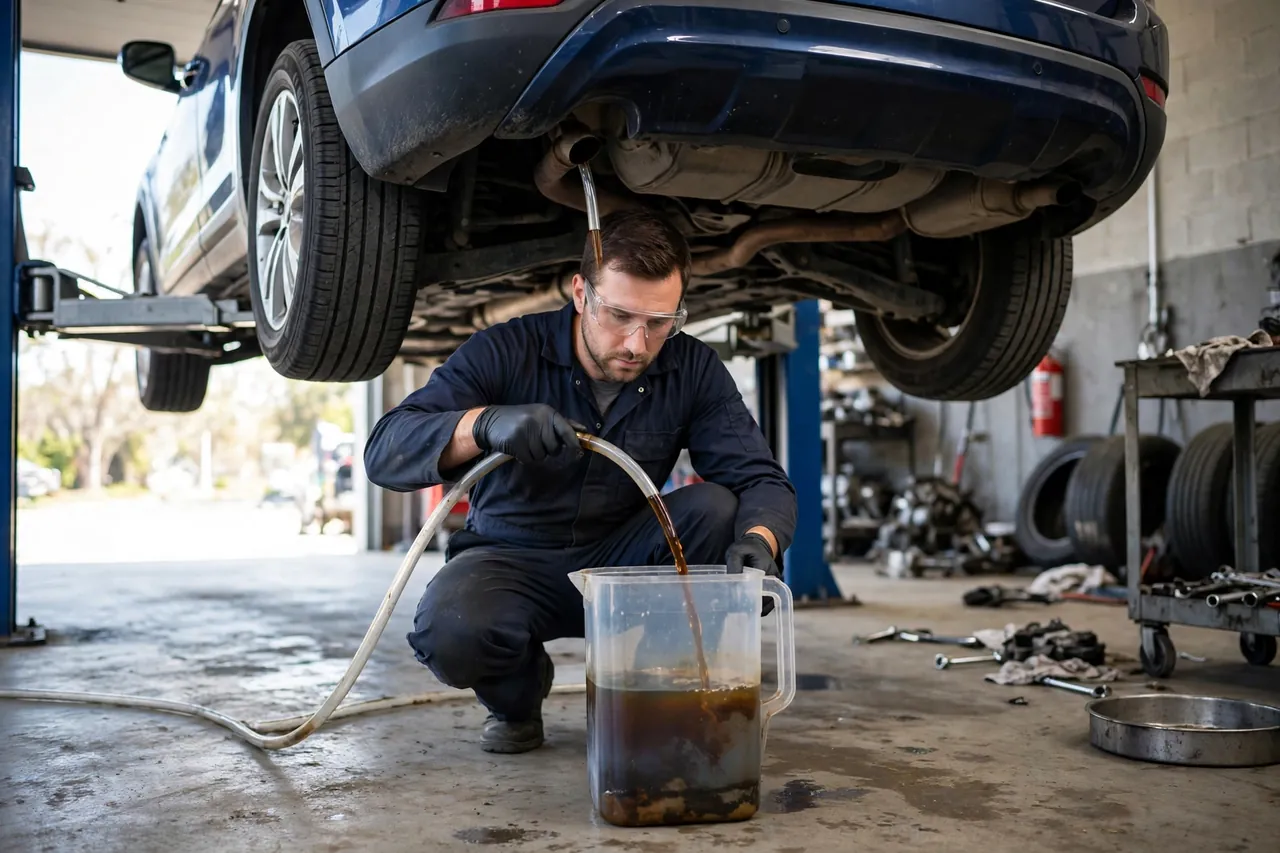
Bad gas usually means one of three things, and they behave differently. Water in the fuel is the most common: it gets in through a poorly sealed underground tank after heavy rain, through condensation in a tank that sits half-empty for months, or through ethanol phase separation. Most pump gasoline in North America contains up to 10 percent ethanol, and ethanol readily absorbs water — an EPA technical memo cited by The Motor Guy explains that a 10 percent ethanol blend can hold water up to about 0.5 percent of its volume, roughly 3.8 teaspoons per gallon, before the water separates out as a layer at the bottom of the tank, right where the fuel pump draws from. Once separated, no additive can re-mix it; the separated layer has to be drained. Stale fuel is the second kind: gasoline left in a car, a snow blower or a jerry can for six months loses its volatile components and leaves varnish in the system, and the engine runs rough or not at all. Diesel in a gasoline tank is the third and the most serious — do not start the engine, do not even turn the key to prime the pump, because the moment the pump runs, diesel is pushed through the whole system. Jerry.ai's 2026 guide is blunt on this point: if the symptoms are severe — knocking, stalling — stop driving to avoid damage.
Water is the culprit a Canadian winter makes worse. A little water in the tank can freeze in the fuel lines overnight at -20°C, and the car that sputtered yesterday will not start this morning. Keep the tank at least half full in winter to limit condensation, buy fuel at busy stations with high turnover, and never let a car sit for months with a near-empty tank. The jar test is the cheap way to confirm the suspicion before paying a shop: draw a fuel sample into a clear jar and let it settle. Contaminated fuel looks cloudy or carries visible specks, and fuel with a separated layer at the bottom has water in it. A sour, varnish-like or sour-milk smell is the other sensory clue — stale fuel and phase-separated ethanol both smell wrong, and fresh gasoline does not smell like varnish.
The fix starts with diagnosis, not parts, and the costs scale with how far the bad fuel got. A diagnostic scan at $95 to $130 CAD will show misfires and fuel trim faults that confirm the fuel is the problem rather than a sensor, and a shop can test a fuel sample for water. For a small amount of water or mild staleness, a fuel system cleaning at $115 to $195 CAD and a fresh fill of quality fuel is often enough, along with a fuel filter replacement at $105 to $185 CAD where the filter is serviceable. The Motor Guy puts a full drain, filter replacement and refill at $150 to $400 USD — roughly $210 to $560 CAD — for badly stale, contaminated or water-separated fuel. Jerry.ai puts the same drain-and-filter job at $200 to $600 USD, roughly $280 to $840 CAD, and notes that a fuel tank removal and cleaning runs $300 to $800 USD, roughly $420 to $1,120 CAD. The two sources disagree by about a third, which is normal: the lower figure is a straightforward drain on an accessible tank, the higher one covers tanks that have to come out. If the contamination reached the injectors, one injector costs $240 to $495 CAD to replace, and if the car was driven on bad fuel for a while, a fuel pump that ran dry or sucked debris costs $440 to $875 CAD. A professional diagnostic at $100 to $180 CAD is the deeper check that maps exactly what the contamination damaged before you authorise the big items.
The decision rule is severity, in this order: if the car still runs and the symptoms are mild, top off with fresh fuel from a different station and add a fuel dryer — an isopropanol-based additive that absorbs small amounts of water — and see if it clears over one tank. If the symptoms are strong, the car stalls, or the fuel sample shows a separated layer, do not keep driving: have the tank drained and the filter replaced, because every kilometre on contaminated fuel pushes debris deeper into the injectors and the pump. If diesel went into a gasoline car, do not start it at all — have it towed and drained. And keep the receipt from the station, with the time of the fill: if other drivers report the same station the same day, the station's insurer is the one who should be paying, not you. In Canada, a station that sold contaminated fuel is a consumer-protection and insurance matter, and a dated receipt plus a shop invoice showing water in the sample is the evidence that makes the claim. For a model-specific estimate of the repair, run your car through the RepairPrice calculator (calculator.php). If the scan points at the injectors or the pump rather than the fuel itself, the companion guides Fuel Injector Replacement and Fuel System Cleaning Cost and Fuel Pump and Fuel Filter Replacement Cost cover those repairs, and Fuel Economy Suddenly Worse: Causes and Fixes covers the consumption symptoms that bad fuel shares with sensor faults.
Common questions:
Q: What are the symptoms of bad gas in a car? A: Sputtering, hesitation under acceleration, rough idling, stalling, hard starting and a check-engine light — usually within a few kilometres of a fill-up. The Motor Guy's 2026 guide lists seven symptoms, and the timing is the giveaway: a car that ran fine before the fill and badly right after it almost certainly got bad fuel.
Q: How much does it cost to fix bad gas? A: It scales with severity. The Motor Guy puts a drain, filter replacement and refill at $150 to $400 USD, roughly $210 to $560 CAD. Jerry.ai puts the same job at $200 to $600 USD, roughly $280 to $840 CAD, with tank removal and cleaning at $300 to $800 USD. A fuel additive treatment for mild cases is $10 to $25. If injectors or the pump were damaged, the bill climbs into four figures.
Q: Can I drive with bad gas in my tank? A: If the symptoms are mild, a short drive to a shop or to dilute the tank with fresh fuel is usually survivable. If the car stalls, knocks loudly or will not start, stop driving — Jerry.ai's guide is explicit that severe symptoms mean towing, not driving, because contaminated fuel damages injectors, the pump and the catalytic converter the longer it circulates.
Q: Does bad gas go away on its own? A: Mild staleness sometimes improves as fresh fuel dilutes the tank, and a fuel dryer additive can absorb small amounts of water. But phase-separated water — the layer at the bottom of the tank once ethanol has absorbed more than about 0.5 percent water, per the EPA memo — cannot be re-mixed by any additive. That layer has to be drained, and the filter replaced.
| Service | Typical range (CAD) | Notes |
|---|---|---|
| Fuel dryer additive (mild water) | $10–$25 CAD | Isopropanol-based; small amounts of water only |
| Diagnostic scan | $95–$130 CAD | Misfires and fuel trim faults confirm bad fuel |
| Fuel system cleaning | $115–$195 CAD | Deposits, uneven flow, mild misfires |
| Fuel filter replacement | $105–$185 CAD | Where the filter is serviceable |
| Professional diagnostic | $100–$180 CAD | Maps exactly what the contamination damaged |
| Tank drain + filter + refill | $210–$560 CAD | The Motor Guy $150–$400 USD; Jerry.ai $200–$600 USD |
| Tank removal and cleaning | $420–$1,120 CAD | Jerry.ai $300–$800 USD |
| One fuel injector | $240–$495 CAD | If contamination reached the injectors |
| Fuel pump replacement | $440–$875 CAD | Pump $200–$550 + about 2.5 h labour |


 RepairPrice
