
Alternator Replacement Cost in Canada
By Oleksandr Potapenko · 2026-11-16 · How we research prices
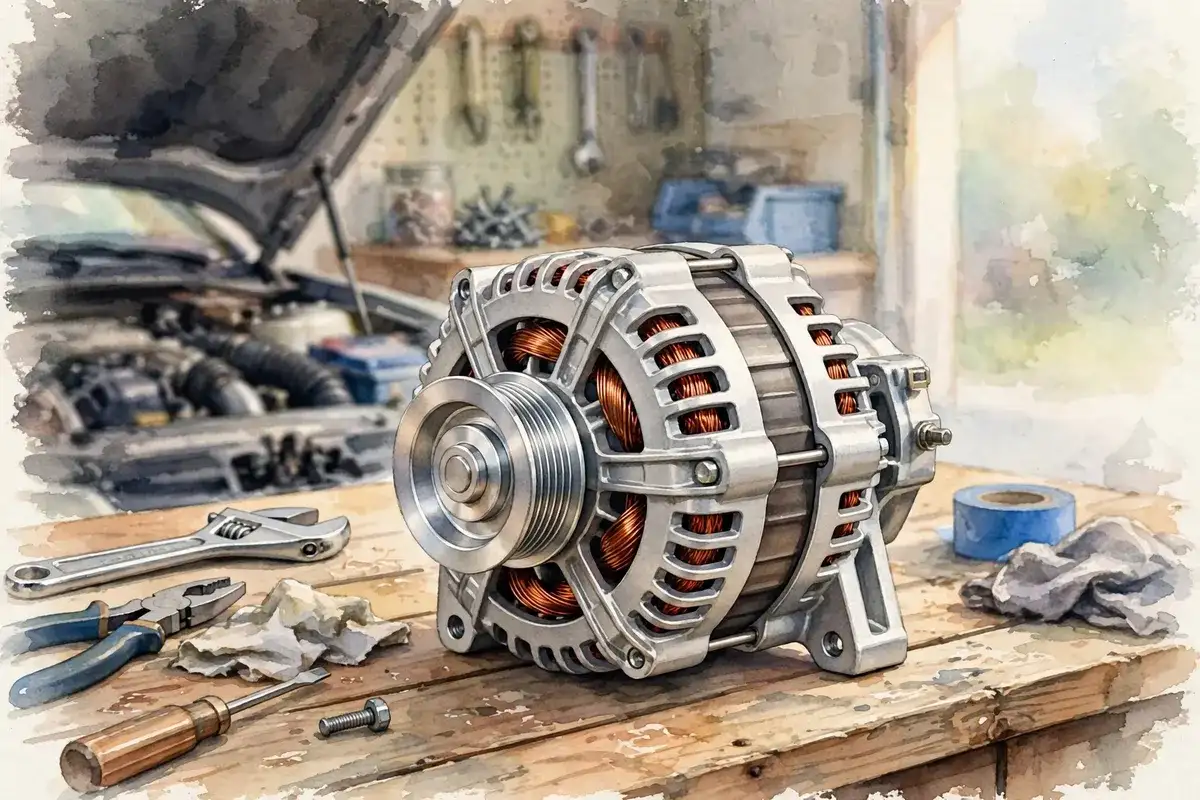
Your battery light comes on, the headlights dim at idle, and the car dies twenty minutes after a jump start. That sequence points at the alternator far more often than at the battery, and it is the most expensive common mistake in the charging system: paying for a new battery when the alternator was the problem all along. Before you approve anything, insist on two tests that take ten minutes. A load test on the battery, and a charging-system test that measures alternator output at idle and at 2,000 rpm. A Canadian alternator guide from WarrantyChick makes the same point bluntly: always demand a battery load test and a serpentine belt inspection first, because a dying battery or a slipping belt mimics alternator failure for a fraction of the cost.
In Canada, replacing an alternator generally costs $600 to $1,400 at an independent shop, or $900 to $1,800 at a dealership, according to WarrantyChick's 2026 Canadian guide. The range is wide because the part itself swings so much. A remanufactured unit for a compact car can cost a few hundred dollars, while a genuine OEM alternator for a modern truck or SUV can pass $1,000 for the part alone. Labour usually runs one to three hours depending on how buried the alternator is under the hood, and most shops bill half an hour to an hour of diagnostic time just to verify the charging circuit. Canadian shop labour in 2026 runs $120 to $180 an hour at independents and $160 to $250 or more at dealers, and parts carry an import and currency premium over US prices, which is why an American forum quote almost never matches the estimate on a Canadian service advisor's desk.
American data helps explain why published averages disagree so sharply. RepairPal's estimator, updated September 3, 2026, puts the average US alternator replacement at $809 to $1,088, with parts at $613 to $800 and labour at $196 to $288. Kelley Blue Book's guide lands lower, at $747 to $842. And ARI, which analysed 556,458 real invoices from 3,622 independent US shops between November 2025 and October 2026, reports a median of just $464, with the middle half of invoices between $288 and $640. The gap is not an error; it is a parts choice. RepairPal prices OEM-grade parts, ARI's invoices reflect what independent shops actually install, which is often a quality remanufactured unit. When a Canadian quote lands far below the RepairPal-style average, ask which part it is. A remanufactured alternator from a reputable brand with a solid warranty is a legitimate way to save several hundred dollars; a no-name rebuild with a 90-day warranty is not.
Model and year move the price more than most drivers expect. RepairPal's model-year data shows a 2009 Toyota RAV4 at $488 to $843, a 2013 Toyota Highlander at $873 to $1,485, and a 2017 Highlander at $1,055 to $1,280, all in US dollars before tax. The pattern is consistent: newer cars with higher-output alternators, tighter engine bays, and more electronics cost more, and luxury cars cost the most of all. A BMW 530i or a full-size Ford F-150 EcoBoost can need three to four hours of labour where a Honda Civic needs under two. If your quote seems high, ask for the labour hours on the estimate and compare them with the book time for your exact engine; access, not dishonesty, is usually the explanation.
The decision rule is straightforward. If the alternator has failed a charging test, the bearings are growling, or the car stalls once the battery's reserve is spent, replace it; there is no safe way to nurse a dead alternator, and every kilometre you drive on battery power alone brings you closer to a tow. If the symptoms are intermittent, dimming lights or an occasional warning light, test first and replace the serpentine belt at the same time if it is cracked or glazed, since a slipping belt undercharges the battery and will kill a new alternator's reputation unfairly. When the alternator does come out, ask the shop to replace the belt if it is due and to test the battery, because a weak battery forces the new alternator to work at full output constantly and shortens its life. And get the quote in writing with the part brand and warranty stated. A remanufactured unit should carry at least a one-year warranty; an OEM unit usually carries more.
Dealer versus independent is a real choice here, not just a price gap. A dealer supplies the factory part and knows your model's quirks, but at $160 to $250 an hour the labour alone can add hundreds. A good independent shop with a quality remanufactured or new aftermarket alternator will usually land 30 to 40 percent lower and is the right call for most cars over five years old. The exception is a car still under warranty or a model where the alternator is integrated with complex electronics; there, the factory part and the dealer's scan tools earn their premium. Run your quote through the RepairPrice calculator (calculator.php) and our guide Dealership vs Independent Garage: How Much Can I Really Save? before you decide. And if the battery light is on right now, read Car Won't Start: Battery, Starter, or Alternator? and Dashboard Warning Lights: What Each One Means first; a ten-minute test is cheaper than a four-figure part.
Common questions:
Q: How do I know if it is the alternator or the battery? A: A battery problem usually shows up as slow cranking or a no-start after the car sits. An alternator problem shows up as dimming lights, a battery warning light while driving, or a car that starts with a boost and then dies again. A charging-system test settles it in minutes, and any shop that skips the test and quotes an alternator is guessing.
Q: Can I drive with a bad alternator? A: Only as far as the nearest shop. The car runs on the battery alone, and once the battery's charge is spent the engine stalls, often without warning and often in traffic. A tow costs less than the accident or the second repair that follows a roadside stall.
Q: Is a remanufactured alternator worth it? A: Yes, if it comes from a reputable brand with at least a one-year parts and labour warranty. ARI's invoice data shows most independent-shop alternator jobs land well below the OEM-priced averages precisely because remanufactured units are common. Avoid no-name rebuilds with short warranties.
Q: How long does an alternator last? A: Typically 7 to 10 years or 150,000 to 250,000 km, but Canadian winters, road salt, and heavy accessory loads such as heated seats and defrosters shorten that. A slipping serpentine belt or a weak battery can also kill an alternator early, which is why both should be checked with every replacement.
| Vehicle | Typical range | What moves the price |
|---|---|---|
| Standard car | $600–$1,200 | Parts $350–$750, 1–2 hours labour |
| SUV / truck | $650–$1,350 | Higher-output alternator, harder access |
| Luxury / European | $800–$1,600 | Factory parts, harder access |
| Remanufactured alternator | Below new-part price | Quality brand + warranty matters |
| Dealer replacement | $900–$1,800 | Factory part, higher labour rate |




 RepairPrice
